



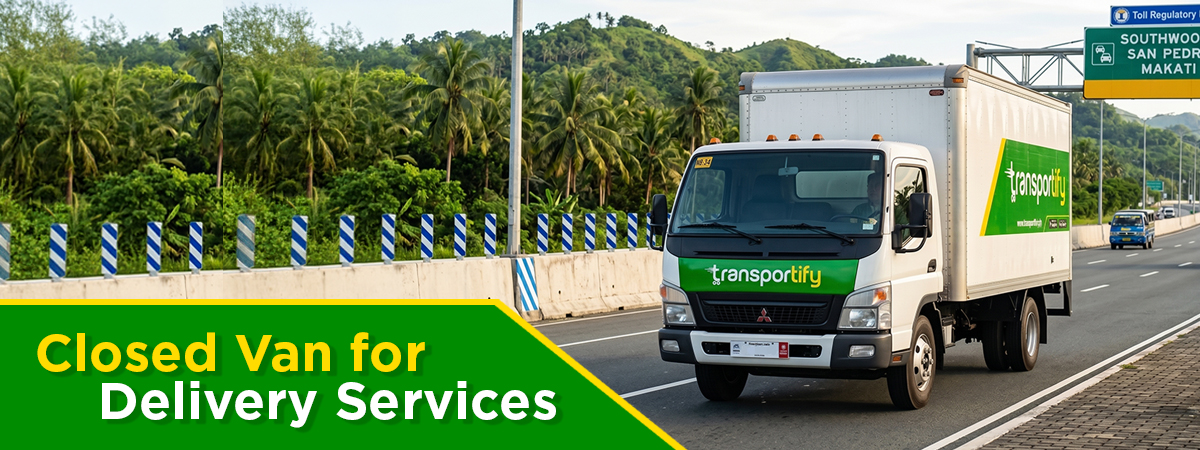
A closed van is a fully enclosed cargo truck with solid walls and a sealed roof to protect delivery goods from rain, dust, and theft during transport. Closed vans in the Philippines are available as 4-wheeler and 6-wheeler trucks. Closed van box bodies measure to 10 to 14 feet long, 6 feet wide, and 6 feet high and carry between 2,000 and 5,000 kilograms of cargo per trip.
Closed van shipping is a popular vehicle-based delivery method in the Philippines for small to large cargo. Closed van delivery services cover both household moves and commercial distribution. The enclosed body of a closed van handles furniture, appliances, bulk retail stock, office equipment, and packed household goods.
Transportify offers 4-wheeler and 6-wheeler closed vans for delivery across Luzon, Visayas, and Mindanao. Transportify’s base price for closed vans start at PHP 1,600 for a regular 2,000 kg unit in Metro Manila. Shippers who need a full day of delivery runs can book a closed van for a 10-hour shift at PHP 6,000. For heavier cargo, Transportify’s Extra Load option scales closed van capacity up to 5,000 kg per trip. Every booking includes GPS tracking, a screened driver-partner, 24/7 live chat customer support, and one free helper,
What Are the Advantages of Using Closed Van for Delivery Services?
Closed vans offer five core advantages that make them the preferred cargo vehicle for both personal and commercial deliveries in the Philippines. Closed vans’ enclosed body design addresses the most common causes of cargo damage and loss during transit. Closed vans provide a more reliable option than open trucks for shippers who need consistent cargo conditions from pickup to final delivery.
- Cargo Protection: The fully enclosed body keeps goods sealed from road debris, dust, and physical impact throughout the trip.
- Weather Resistance: The solid walls and a sealed roof shield shipments from rain, humidity, and direct sunlight. Closed vans are reliable during the Philippine wet season and during high-heat events during the summer.
- Theft Prevention: The lockable cargo area hides goods from view and deters theft along busy urban routes and overnight provincial trips.
- Secure Transport: The enclosed structure helps keep goods from shifting or falling during transit. Closed vans keep loads stable across rough roads, sharp turns, and multi-stop delivery routes.
- Suitability for Fragile and High-Value Goods: Electronics, glassware, antiques, and high-value merchandise travel inside a controlled enclosed space that open trucks cannot provide. Closed vans lower the likelihood of breakage or loss.
The advantages of using closed van delivery services extend from basic protection to better control over every trip. Transportify strengthens each of these benefits by pairing every closed van booking with a screened driver-partner, a free extra helper for careful loading and unloading, and real-time GPS tracking so both shippers and recipients stay informed at every point of the delivery.
What Is a Closed Van in Delivery Logistics?
A closed van in delivery logistics is an enclosed light commercial vehicle with a sealed cargo body. Closed vans are used to secure last-mile and mid-range freight transport across urban and provincial routes. Closed vans in Philippine logistics are classified as dry vans. Dry vans carry non-perishable, non-refrigerated goods inside a fully sealed box structure built from corrugated galvanized iron sheets or lightweight composite panels. A closed van focuses on physical security and environmental protection unlike refrigerated vans or open dropside trucks. The properties of closed vans make it the standard choice for general commercial freight and household cargo transfers in the Philippines.
Closed vans in the Philippine market span a range of capacities and chassis types, from compact 4-wheeler Elf units to heavier 6-wheeler Canter trucks. This wide range of closed vans allows it to serve both small business deliveries and full household moves without requiring a larger and more expensive truck class. Transportify lists different weight capacities for closed vans directly in its app. Shippers can select the right unit size for their cargo volume and book on demand without negotiating rates or coordinating with a separate trucking company.
How Does a Closed Van Protect Cargo During Transport?
A closed van protects cargo through a fully sealed compartment structure that isolates goods from road conditions, weather, and external contact throughout the entire delivery trip. The cargo body consists of solid side panels, a fixed roof, and a reinforced rear door with a locking mechanism. The closed van’s cargo body creates a physical barrier that prevents external debris, and unauthorized access from reaching the goods inside.
The locked rear door blocks tampering and theft at every stop along the delivery route, including overnight parking and multi-drop urban trips. The solid walls also absorb minor road impact and reduce vibration transfer to the cargo. The reduced vibration lowers the risk of breakage for stacked or fragile items during transport on rough provincial roads or congested city streets. The combination of physical enclosure, lockable access, and structural impact resistance makes the closed van a practical choice for shippers handling sensitive or high-value goods,
What Types of Goods Are Transported Using Closed Vans?
Closed vans transport a wide range of goods that need protection from external factors during delivery. Closed vans function as general-purpose dry vans for non-perishable cargo that cover both everyday retail distribution and higher-risk shipments that cannot travel on open trucks.
- Electronics: Computers, televisions, mobile devices, and audio equipment travel inside closed vans to reduce moisture exposure and physical shock during transit.
- Retail Goods: Clothing, shoes, packaged consumer products, and general merchandise move from warehouses to retail stores and e-commerce customers using closed van delivery routes.
- Appliances: Large household and commercial appliances such as refrigerators, washing machines, and air conditioning units rely on the enclosed space and load capacity that closed vans provide.
- Packaged Food: Dry and shelf-stable food products, canned goods, and packaged snacks are transported in closed vans to maintain product integrity and prevent contamination from road dust and humidity.
- Pharmaceuticals: Medicine, supplements, and medical supplies that are sensitive to environmental exposure use the sealed environment of a closed van to preserve product quality across delivery routes.
- Documents: Confidential files, legal documents, and business records depend on enclosed and lockable transport to protect their contents and prevent unauthorized access during delivery.
The types of goods show the versatility of closed vans in being able to support small online shops to large distributors and healthcare providers. Transportify turns this versatility into a practical option by allowing bookings for mixed loads, offering an extra helper for handling bulky items, and providing GPS tracking so sensitive cargo like appliances, electronics, or documents can be monitored from dispatch to drop-off.
Is Shipping Insurance Necessary for Protecting Cargo Transported via Closed Vans?
Yes, shipping insurance is necessary for protecting high-value or fragile cargo transported via closed vans, even though it is not legally required for deliveries in the Philippines. A closed van’s enclosed structure reduces the physical risk of damage during transit, but it does not eliminate liability exposure from road accidents, vehicle breakdowns, or handling errors at loading and unloading points. Electronics, pharmaceuticals, and documents carry additional replacement costs that far exceed standard carrier liability limits. Cargo insurance acts as a practical safeguard rather than an optional extra.
Why Are Closed Vans Preferred for Urban Delivery Services?
Closed vans are preferred for urban delivery services because their compact dimensions, sealed cargo body, and multi-stop capability make them an operationally practical freight vehicle for dense city environments in the Philippines. The closed van’s overall length of 10 to 14 feet allows them to navigate narrow barangay roads, tight commercial loading bays, and congested intersections in Metro Manila where larger trucks cannot operate freely. The lockable cargo area also removes the need for additional security measures at each delivery stop, which reduces dwell time per drop-off and keeps the route moving efficiently even across 10 to 15 destinations in a single trip. Last-mile delivery in Philippine cities involves traffic volume, narrow access roads, informal loading zones, and frequent stops at residential and commercial addresses. Closed vans address these conditions simultaneously by combining compact vehicle dimensions with full cargo enclosure.
What Is the Cargo Capacity of a Closed Van?
A closed van in the Philippines carries between 2,000 and 5,000 kilograms of cargo depending on the unit type. The standard box dimensions of a closed van is 10 to 14 feet long, 6 feet wide, and 6 feet high. The 4-wheeler closed van handles a base payload of 2,000 kilograms, with interior dimensions of 200 cm long, 180 cm wide, and 175 cm high which makes it the standard unit for light commercial deliveries and household moves in Metro Manila. The 6-wheeler closed van carries the same 2,000 kilogram base payload but with a longer cargo body reaching up to 9.2 feet in usable length. 6-wheeler closed vans have more floor space for bulky goods like furniture and appliances.
Transportify offers extra load upgrades that push capacity to 3,000, 4,000, or 5,000 kilograms for a corresponding fee increase. Transportify’s extra load options cover heavier commercial cargo without requiring a full forward truck class. Philippine urban road restrictions such as weight limits on secondary roads and bridges, make this capacity range practical since closed vans stay within the axle load thresholds that apply to light and medium commercial trucks.
How Do Closed Vans Differ From Open Trucks in Logistics?
A closed van differs from an open truck primarily in cargo enclosure. The closed van uses a sealed box body that fully covers all four sides and the roof, while an open truck uses a flatbed or dropside body that leaves cargo fully or partially exposed to the elements. The structural difference between closed vans and open trucks determines which cargo types each vehicle suits. Open trucks handle raw materials, construction supplies, and heavy equipment that are not sensitive to weather or external contact. Closed vans handle finished goods, packaged products, and sensitive items that require a protected environment during transit.
Open trucks allow access from the sides and top using forklifts or cranes. Open trucks are faster for bulk palletized cargo at warehouses and industrial sites. Closed vans load from the rear door only, which slows bulk loading but keeps cargo sealed and secure between stops. The closed van’s enclosure and security outweigh the loading flexibility of an open truck in most last-mile delivery scenarios for Philippine businesses shipping retail goods, documents, and appliances across city routes.
When Should You Use a Closed Van for Delivery Services?
A closed van is the right choice when cargo requires physical protection, environmental shielding, or security against theft during transit. This applies directly to sensitive shipments where exposure to rain, dust, road vibration, or unauthorized access could result in product damage and financial loss.
Shippers moving electronics, glassware, or ceramic materials benefit from the enclosed compartment that absorbs minor road impact and prevents direct contact with external elements. Businesses distributing packaged food, pharmaceuticals, or documents across Metro Manila routes rely on the sealed environment to maintain product integrity and confidentiality across multiple drop-off points. Households transferring furniture and appliances during a lipat-bahay also benefit from the full enclosure, which keeps large items clean, dry, and secure throughout an entire moving day. A closed van is practical over an open truck when the shipment involves goods that cannot be wrapped adequately, delivery spans several hours across different barangays, or the route includes overnight stops where cargo is unattended.
How Is Cargo Loaded and Secured Inside a Closed Van?
Cargo inside a closed van is loaded through the rear door and secured using a combination of strapping, stacking, and space-filling techniques that prevent movement during transit. Proper load securing reduces the risk of breakage, shifting, and driver distraction caused by unstable freight on rough provincial roads and sharp urban turns.
Tensioning straps is a common securing method for closed vans. Tensioning straps are anchored to floor and sidewall anchor points inside the cargo body to press goods firmly against the floor to increase friction by up to 40% and prevent lateral movement during braking and cornering. Load bars are placed horizontally between the sidewalls to divide cargo into sections and create physical barriers between stacked loads of different sizes or weights. Heavier items are loaded first and placed at the bottom and closest to the cab wall to lower the vehicle’s center of gravity and reduce tipping risk during sharp turns. Lighter and more fragile items are stacked on top and toward the rear door, with foam padding or cardboard separators between layers to absorb road vibration. Remaining gaps between cargo units are filled with inflatable dunnage bags or packing material to prevent boxes from shifting freely inside the compartment during transit. Transportify’s closed van bookings include a free extra helper who assists with proper loading and stacking at both pickup and delivery points to reduce the risk of improper load arrangement that leads to cargo damage.
Do Cargo Trucking Services in the Philippines Commonly use Closed Vans for Deliveries?
Yes, cargo trucking services in the Philippines commonly use closed vans for deliveries. The closed van is the most widely deployed medium-duty freight vehicle across both app-based logistics platforms and traditional trucking companies.
Closed Van Elf and Canter chassis units are highly available in the local market hence operators maintain large fleets of closed vans at different sizes. Closed vans can carry many cargo types ranging from appliances to documents. The high availability and cargo variability make closed vans the default choice for SME distributors, freight forwarders, and household movers across Luzon, Visayas, and Mindanao.
Closed Van Elf and Canter chassis units are highly available in the local market hence operators maintain large fleets of closed vans at different sizes. Closed vans can carry many cargo types ranging from appliances to documents. The high availability and cargo variability make closed vans the default choice for SME distributors, freight forwarders, and household movers across Luzon, Visayas, and Mindanao.
What Industries Rely on Closed Van Delivery Services?
The industries that rely on closed van services include e-commerce, retail distribution, FMCG, pharmaceuticals, and electronics logistics. Closed van delivery services support these industries in the Philippines by providing a secure, enclosed transport for finished goods and time-sensitive shipments.
- E-Commerce: Online retailers and marketplace sellers use closed vans for last-mile fulfillment. The enclosed body protects parcels from rain and road dust during multi-stop delivery runs.
- Retail Distribution: Supermarkets, convenience stores, and specialty shops rely on closed van deliveries to replenish store shelves from central distribution centers. The sealed cargo area keeps packaged goods clean and undamaged during high-frequency city routes.
- Fast-moving consumer goods (FMCG): Fast-moving consumer goods companies distribute food, beverages, personal care products, and household items using closed vans that can cover multiple store accounts in a single trip. Consistent product condition on arrival is a key requirement for FMCG distributors operating in dense urban markets.
- Pharmaceuticals: Drugstores, hospitals, and medical supply companies transport medicines, supplements, and healthcare equipment in closed vans to protect product quality from environmental exposure during transit. Maintaining the integrity of pharmaceutical goods between supplier and end point is a compliance and safety requirement.
- Electronics Logistics: Consumer electronics brands and appliance retailers use closed vans to move high-value units from warehouses to stores and direct-to-customer delivery addresses. The enclosed, lockable compartment reduces theft risk and physical damage during urban distribution.
Closed vans function as a shared logistics backbone for multiple industries and businesses that cannot risk product damage or loss en route. Transportify supports these sectors by offering on-demand and scheduled closed van services nationwide. Companies can use Transportify to align vehicle capacity and cost with their actual delivery volumes instead of maintaining their own truck fleet.
How Much Does Closed Van Delivery Cost in the Philippines?
Closed van delivery in the Philippines costs between PHP 1,450 and PHP 2,100 as a base rate per trip, with additional charges applied per kilometer traveled beyond the base coverage zone. Rates vary depending on the service area, van size, distance, and extra services.
Closed van delivery pricing in the Philippines follows a base-rate-plus-distance structure. A standard trip in Metro Manila starts at a fixed base rate that covers a defined minimum distance, with a per-kilometer charge applied for every kilometer beyond that threshold. Full-day bookings are priced separately as a flat fee that covers the vehicle and driver for up to 10 hours, Full-day bookings are cost-efficient for shippers with multiple stops or long-haul provincial trips.
Transportify’s closed van rates start at PHP 1,600 base price in Metro Manila and PHP 1,450 outside Metro Manila and across Visayas and Mindanao. A full-day 10-hour rental is available at PHP 6,000, and multi-destination bookings of up to 15 drop-off points are available at PHP 160 per additional destination.
What Factors Affect Closed Van Delivery Pricing?
The factors that affect closed van delivery pricing include distance, weight, urgency, fuel cost, loading complexity and service type. A closed van shipper that understands each factor makes a more accurate estimate of their total spend before booking.
- Distance: The total kilometers traveled from pickup to final drop-off point is the primary driver of delivery cost. Longer routes beyond the base coverage zone add a per-kilometer charge on top of the fixed base rate.
- Weight: Heavier and larger cargo increases the price of closed van delivery.
- Urgency: Same-day and on-demand bookings are generally priced higher than scheduled deliveries. Peak periods such as holidays, sales events, and rainy season demand surges also affect real-time availability and pricing.
- Fuel Cost: Fuel surcharges apply on logistics platforms during periods of elevated diesel prices, directly affecting the per-kilometer rate added to the base price.
- Loading Complexity: Deliveries that require additional helpers, special handling, or extended loading and unloading time at the pickup or drop-off point carry extra service charges beyond the standard booking rate.
- Service Type: Per-trip bookings, full-day rentals, and multi-destination deliveries are each priced differently. Full-day rates offer better value for shippers with dense delivery routes, while per-trip bookings suit single-stop or point-to-point shipments.
The factors that affect closed van delivery pricing interact on every trip. Two bookings with the same route can still have different prices depending on weight, urgency, and service type. Tools like Transportify’s Price Wizard help shippers see how changes in distance, load, or route structure affect the final closed van delivery cost before they confirm a booking.
Can Trucking Quotes Online be Used to Estimate Closed Van Delivery Costs?
Yes, trucking quote online can be used to estimate closed van delivery costs. Logistics platforms in the Philippines provide real-time price calculators that generate instant rate estimates based on route, vehicle type, and cargo details. Online price calculators remove the need for manual rate negotiation with individual trucking companies. Shippers get a transparent cost estimate before committing to a booking.
Transportify’s Price Wizard calculator provides instant trucking quotes for closed van bookings across all its service areas in Luzon, Visayas, and Mindanao. Shippers enter their pickup location, destination, and cargo weight to receive an immediate rate estimate. Transportify’s Price Wizard is a fast way to plan delivery costs before booking.
How Does Booking a Closed Van Work Through Transportify?
Booking a closed van through Transportify works through a fully digital process on the mobile app or web app. Customers enter the pick-up and drop-off locations, select “Closed Van” from the vehicle list, and see an instant price estimate before confirming the booking. The system then matches the request with an available closed van in the area based on location, vehicle size, and timing, so the nearest suitable unit is dispatched to the pickup point. Customers can add extra services, such as additional helpers or extra load capacity, within the same booking flow, and track the assigned vehicle in real time from dispatch until the final delivery.
What Safety Measures Are Used in Closed Van Deliveries?
The safety measures used in closed van deliveries include cargo locks, driver verification, GPS tracking and sealed compartments. Closed van delivery services in the Philippines apply several safety measures to protect cargo and give shippers visibility and control over each trip.
- Cargo locking systems: Closed vans use rear door locks and, in some fleets, additional padlocks or latch mechanisms to prevent unauthorized access to the cargo area during stops and overnight parking.
- Driver verification: Logistics platforms like Transportify verify driver identities using government IDs, NBI clearances, and in-app profiles, and provide customers with the driver’s name and profile so they can confirm who is handling their cargo.
- GPS tracking: Real-time GPS tracking lets shippers and recipients follow the closed van’s location on a map, monitor estimated time of arrival, and receive status updates from pickup to drop-off.
- Sealed compartments: The enclosed cargo body shields goods from weather and road debris, and helps keep packages intact and out of sight, which reduces tampering risk during multi-stop routes.
Closed van safety measures work together to protect both the physical cargo and the delivery process itself. The safety measures give businesses and households more confidence when they ship valuable or sensitive goods by closed van.
How Do Closed Vans Improve Efficiency in Urban Delivery Networks?
Closed vans improve efficiency in urban delivery networks by reducing delivery failures, supporting better route execution, and keeping city logistics operations more predictable. The enclosed cargo area allows drivers to complete multiple drop-offs without repacking or re-covering goods at each stop. This shortens handling time per delivery and lowers the chance of damage that leads to returns or failed deliveries.
Traffic, narrow streets, and limited loading zones slow down operations in dense Philippine cities. Closed vans address this by consolidating many orders into one vehicle while keeping every shipment protected throughout the route. A single closed van can serve several barangays or commercial clusters in one trip instead of sending multiple smaller vehicles for the same cargo volume.
Multi-stop capability, cargo security, and consistent handling make closed vans a reliable asset for urban delivery networks for logistics teams. Transportify supports this further through real-time GPS tracking and automated fleet matching, so closed van bookings are dispatched and routed efficiently without manual coordination between shippers and drivers.







 Chat
Chat