



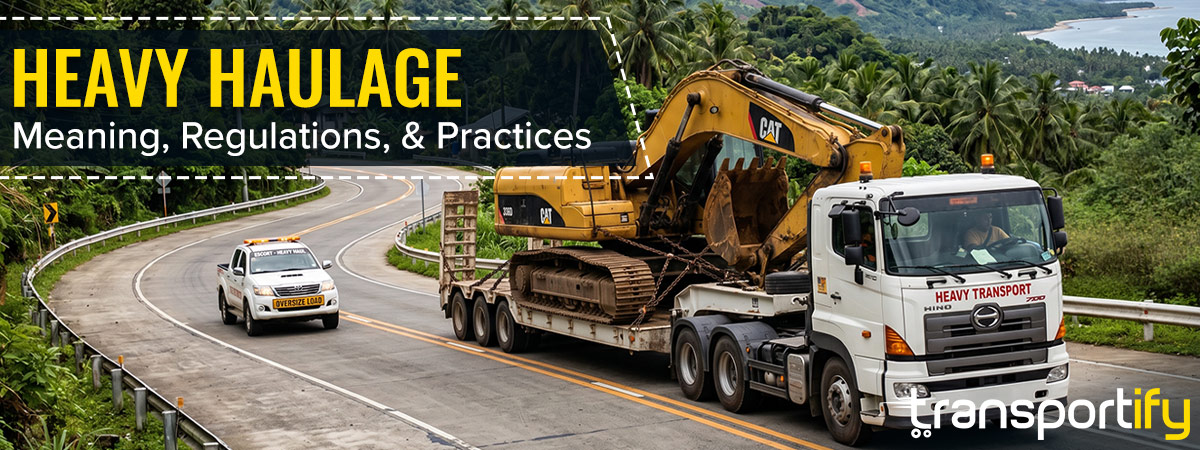
Heavy haulage is the transport of abnormal, oversized, or overweight cargo that exceeds the standard legal limits for weight, width, height, or length permitted on public roads. Heavy haulage requires specialized equipment, permits, and route planning to move safely.Heavy haulage relies on multi-axle trailers, high-powered prime movers and escort vehicles as standard freight trucks cannot physically carry heavy haul freight. Heavy haulage cargo ranges from wind turbine blades, industrial machinery, steel structures, and large construction units that are too big for conventional road transport.
Heavy haulage in the Philippines is governed by Republic Act No. 8794 (R.A. 8794). R.A. 8794 sets the maximum allowable single axle load at 13,500 kilograms. The Department of Public Works and Highways (DPWH) issues Highway Travel Permits (HTPs) for vehicles carrying inseparable cargo that exceed prescribed gross vehicle weight limits. Heavy haulage supports infrastructure development, energy projects, and industrial operations across Luzon, Visayas, and Mindanao. The country’s “Build, Better, More” infrastructure program covers 194 flagship projects across roads, bridges, power, and water resources. Projects of this scale depend on compliant heavy haulage operations to deliver the structural components that make large-scale construction possible.
What is Heavy Hauling?
Heavy hauling is the specialized transportation of abnormal and heavy loads that exceed the legal dimensional limits set for standard road use. Heavy hauling is also referred to as heavy haulage, heavy haul trucking, and abnormal load transport across different markets and regulatory jurisdictions. The abnormal load classification applies when cargo is inseparable. Inseparable cargo cannot be broken down into smaller units that fit within standard road limits. Moving inseparable cargo demands a coordinated transport system built around the cargo’s specific dimensions, axle weight distribution, and road compatibility. Heavy hauling requires purpose-built transport systems, structural engineering input, permit acquisition, and coordinated route management to move cargo safely and legally between origin and destination.
Heavy hauling covers a wide range of industrial cargo types. Industrial machinery, construction equipment, power generation components, and prefabricated structural modules are among the common loads transported through heavy hauling operations. Each heavy haul cargo type exceeds the dimensional or weight parameters that standard commercial trucks and trailers are legally or physically capable of handling.
Not all industrial freight requires true heavy haulage. Construction materials, steel components, and large equipment that stay within standard road limits belong to a different transport category. Transportify’s 10-wheeler wing van handles industrial cargo of this type across the Philippines. Transportify gives businesses a faster and more accessible booking option for project-related freight that does not cross into abnormal load territory.
What Qualifies a Shipment as Heavy Haulage?
A shipment qualifies as heavy haulage when cargo exceeds one or more of the standard legal thresholds for weight, axle load, height, width, or overall length on public roads. RA 8794 in the Philippines sets the maximum allowable single axle load at 13,500 kilograms. LTO Administrative Order 2009-018 sets additional dimensional limits for vehicles on national roads. Loads exceeding 2.5 meters in width, 4.0 meters in height, or 12.0 meters in overall length are flagged as oversize A shipment that breaches any one of these thresholds enters the heavy haulage classification. Weight, axle configuration, and physical dimensions are each independent triggers. Any single breach requires a HT before the vehicle can legally proceed.
A single-piece load is treated as heavy haulage when weight passes roughly 25,000 kilograms in global markets. Total gross vehicle weight becomes subject to heavy haul controls when the combination exceeds approximately 36,000 kilograms, requiring additional axles and specialized trailers. Global markets flag loads over 2.6 meters wide, 4.1 meters high, or 16 meters long as oversize cargo subject to heavy haul regulations. Exact thresholds vary by country and road class. Once a shipment crosses any of these thresholds, standard freight classification no longer applies. The move must be engineered as a heavy haul operation, with route clearances, structure checks for bridges and flyovers and coordination with local government units along the planned path.
How is Heavy Haulage Different From Standard Freight Transport?
Heavy haulage differs from standard freight transport in legal classification, engineering depth, routing complexity, and vehicle specialization. Standard freight stays within normal road limits for size and weight. Standard freight also uses common trailers like dry vans and flatbeds, and typically needs no special permits beyond basic commercial registration. Heavy haulage manages loads that exceed standard freight limits and is treated as abnormal transport that must pass additional regulatory checks and permitting steps before each move.
Engineering requirements separate the heavy haulage and standard freight significantly. Standard freight transport requires no structural assessment of the route or the vehicle. Heavy haulage requires detailed engineering calculations for axle loading, center of gravity, load distribution, and tie-down capacity. Heavy haul operations often involve civil and mechanical engineers to review the delivery plan. Standard freight relies on established loading patterns and simple weight checks at origin or along the route. Standard freight route planners focus on distance, tolls, and traffic, while heavy haul planners must also consider bridge capacities, road widths, turning radii, vertical clearances, and any local ordinances on abnormal loads along certain corridors.
Vehicle specialization is a direct consequence of the engineering requirements. Standard freight uses vehicles rated for standard gross vehicle weights. Heavy haulage uses vehicles specifically engineered to distribute extreme loads across a greater number of axles to reduce the per-axle pressure applied to road surfaces. A standard four-axle semi-truck cannot substitute for a purpose-built heavy haul tractor combined with a multi-axle trailer when cargo exceeds standard thresholds.
Are Cargo Trucking Services in the Philippines provide Heavy Haulage operations?
Yes, a limited number of cargo trucking services in the Philippines provide heavy haulage operations. Cargo trucking providers maintain fleets with lowbed trailers, cranes, and heavy-duty tractors. Local cargo trucking service providers handle route surveys, DPWH permitting, and on-site lifting coordination as part of an end-to-end project logistics service for construction, power, and industrial clients.
Can a Cargo Truck FTL Service (Full Truckload) Handle Heavy Haulage cargo movement?
No, a cargo truck FTL service is not designed to handle true heavy haulage. The cargo truck FTL service covers full utilization of a standard truck within legal size and weight limits. A heavy haul move still uses the full capacity of a vehicle, but relies on specialized equipment and oversize permits. Heavy haul requirements sit outside the scope of most conventional FTL offerings.
What Types of Cargo Require Heavy Haulage Operations?
The types of cargo that consistently require heavy haulage operations include construction equipment, wind turbine components, mining equipment, power generation equipment, steel structures, oil and gas equipment, air craft components, large marine vessels and manufacturing plant components. These cargo types consistently require heavy haulage operations because each involves loads that are inseparable, oversized, or overweight.
- Construction Equipment: Cranes, excavators, tunnel boring machines, and bulldozers are heavy by design and cannot be broken down into road-legal units.
- Wind Turbine Components: Turbine blades, nacelles, and tower sections exceed standard road length and height limits and require extendable trailers with engineered route plans.
- Mining Equipment: Haul trucks, draglines, and processing units weigh hundreds of tonnes and are too large for standard trailers, requiring multi-axle heavy haul systems.
- Power Generation Equipment: Transformers and generators are single-piece units that can exceed 300 tonnes and require hydraulic modular trailers to distribute load across multiple axles.
- Steel Structures: Bridge beams, structural frames, and prefabricated steel spans exceed standard length and weight limits and must be moved as abnormal loads with dedicated route clearance.
- Oil and Gas Equipment: Pressure vessels, refinery modules, and pipeline sections are built as inseparable units that exceed dimensional and weight thresholds for standard road freight.
- Aircraft Components: Fuselage sections, wing assemblies, and engine nacelles are dimensionally oversized and structurally sensitive, requiring specialized trailers and careful route planning.
- Large Boats and Marine Vessels: Vessel hulls, dry dock components, and offshore modules exceed road width and height limits and must travel on multi-axle low-loader trailers with police escort.
- Heavy Manufacturing Plant Modules: Prefabricated plant sections such as reactor vessels, distillation columns, and heat exchangers are built offsite and transported as complete modules that exceed all standard road freight thresholds.
Each heavy haul cargo types shares the same fundamental characteristic of being inseparable and exceeds at least one legal threshold for weight, width, height, or length. Infrastructure and energy projects in the Philippines are scaling rapidly under national development programs. The demand for heavy haulage across all cargo types continues to grow alongside the complexity of managing oversized movements through varied terrain, island geography, and urban road networks.
1. Construction equipment
Construction equipment requires heavy haulage because individual machines such as crawler cranes, hydraulic excavators, motor graders, and road rollers are non-divisible units that exceed standard road weight and dimensional limits in their transport-ready configuration. A large crawler crane can weigh between 100 and 1,200 tons and requires disassembly into multiple heavy haulage loads before the chassis itself can move on a lowbed trailer. Construction equipment transport involves time pressure. Equipment mobilization and demobilization directly affect project timelines hence permit acquisition speed and route planning efficiency are critical components of the heavy haulage operation.
Construction equipment heavy haulage in the Philippines is directly tied to the pace of infrastructure development under national programs that cover roads, bridges, expressways, and flood control systems. Equipment for major projects such as the Metro Manila Subway, North-South Commuter Railway, and various DPWH bridge construction contracts must be transported to project sites across urban and provincial routes that pass through narrow local roads and low-clearance structures. Philippine heavy haul operators manage heavy haulage movements through DPWH Highway Travel Permits combined with advance route surveys that identify structural constraints before the equipment departs.
2. Wind turbine components
Wind turbine components are among the most dimensionally challenging cargo in heavy haulage. Turbine blades on modern installations regularly exceed 60 meters in length and cannot be shortened or folded for transport. Tower sections are cylindrical and rigid. Nacelles contain the generator and gearbox assembly in a single housing unit that can weigh over 400 tonnes on utility-scale turbines. Each component demands a different trailer configuration.
Wind turbine heavy haulage in the Philippines is complicated further by the archipelagic geography of the country. Wind farm sites in Ilocos Norte, Negros, and Mindanao sit in locations that require multi-modal transport combining road haulage with Roll-on, Roll-off (RoRo) shipping to reach island or coastal project sites. The emergence of third-generation turbines with blades spanning up to 95.5 meters as pushed operators to deploy specialized blade lifter trailers and prime movers. Specialized vehicles must handle mountainous terrain and remote access roads near wind farm sites.
3. Mining equipment
Mining equipment requires heavy haulage because the machines used in extraction and processing operations are built at a scale that standard road transport cannot accommodate. Large haul trucks used in open-pit mining can weigh over 300 tonnes fully assembled. Draglines, bucket-wheel excavators, and ore processing units are manufactured as single-piece or modular structures that exceed the road limits for conventional trailers. Transporting mining equipment units requires multi-axle hydraulic trailers and high-horsepower trucks.
Mining equipment heavy haulage in the Philippines,serves the country’s active mineral extraction sector. The Philippine’s mining sector includes large-scale nickel, copper, and gold mining operations across Mindanao, Palawan, and the Cordillera region. Access roads to Philippine mining sites are often unpaved and narrow. The complexity of Philippine access roads increases the engineering complexity of moving large equipment from port of entry or fabrication yard to the mine site. Operators frequently coordinate with local government units to secure route clearances and temporary road reinforcements before heavy mining equipment transport can proceed.
4. Power generation equipment
Power generation equipment requires heavy haulage because transformers, generators, gas turbines, and steam turbine housings are manufactured as single inseparable units that routinely exceed the weight and dimensional thresholds. Power transformers used in grid-level electricity transmission regularly weigh between 70 and 400 tons. Power transformer units cannot be drained, disassembled, or segmented for transport without permanently damaging the insulation systems inside. Power generation equipment transport requires hydraulic multi-axle trailers, specialized blocking and bracing systems.
Power generation equipment heavy haulage in the Philippines supports the country’s ongoing capacity expansion across coal, natural gas, geothermal, and renewable energy sectors. Power plant construction in locations such as Batangas, Cebu, Davao, and the Ilocos Region regularly requires the movement of heavy turbines, transformers, and generator sets from seaports to inland plant sites. Philippine heavy haul operators coordinate port clearances, DPWH Highway Travel Permits, and road reinforcement works on routes that pass through urban areas and provincial highways before major equipment moves can take place.
5. Steel structures
Steel structures require heavy haulage because fabricated bridge girders, truss sections, steel columns, and prefabricated structural frames are long, rigid units that exceed standard trailer length limits. Steel structures cannot be bent, folded, or divided without destroying their structural integrity. A single steel bridge girder can measure 40 to 60 meters in length and weigh between 30 and 150 tons depending on the span design and steel grade. Transporting steel structures requires extendable trailers, and route clearances for overhead utility lines, low bridges, and narrow road sections that fall within the structure’s width profile.
Steel structure heavy haulage in the Philippines is most active in bridge construction and elevated expressway projects. Prefabricated girders and steel spans are fabricated at specialist yards and transported to site as complete sections. Projects under the DPWH bridge replacement program and the Metro Manila expressway expansion regularly require steel beam deliveries that travel through congested urban corridors and across older provincial bridges whose load limits fall below the cargo’s actual weight. Route planning for these movements includes structural assessments of every bridge along the path to confirm load capacity before the heavy haul convoy departs.
6. Oil and gas equipment
Oil and gas equipment requires heavy haulage because the industry relies on pressure vessels, heat exchangers, refinery columns, pipeline manifolds, and offshore platform modules that are fabricated as single-piece units at specialist yards and delivered intact to their operational sites. A single distillation column for a refinery installation can reach 60 meters in length and weigh over 500 tonnes. .
Oil and gas equipment heavy haulage in the Philippines primarily serves the refinery and petrochemical sector in Batangas and the offshore energy developments in the Malampaya field and emerging exploration zones in the West Philippine Sea region. Fabricated equipment destined for these projects moves from port facilities to refineries and offshore staging areas along route corridors that pass through industrial zones in Batangas and Cavite. Heavy haulage of oil and gas equipment requires DPWH permits and coordination with the Philippine Coast Guard for equipment staged at coastal facilities.
7. Aircraft components
Aircraft components require heavy haulage because fuselage sections, wing assemblies, empennage units, and engine nacelles are built to exact aeronautical tolerances and cannot be disassembled further for road transport without risking damage. Fuselage barrel sections for wide-body commercial aircraft can exceed 7 meters in diameter and 15 meters in length. Aircraft component transport requires vibration control and precise load positioning during transit because the structural tolerances of aerospace-grade components are far narrower than those of industrial machinery.
Aircraft component transport in the Philippines supports the maintenance, repair, and overhaul (MRO) sector concentrated at Manila’s Ninoy Aquino International Airport (NAIA) and at Clark International Airport in Pampanga. Heavy haulage providers servicing the Philippine aerospace sector coordinate DPWH Highway Travel Permits for overwidth and overlength component loads that move between port facilities, MRO hangars, and aircraft storage areas. The growth of Philippine aviation and the increasing number of domestic carriers operating wide-body commercial aircraft creates a sustained demand for aircraft component heavy haulage services between port reception points and maintenance facilities.
8. Large boats and marine vessels
Large boats and marine vessels require heavy haulage when hulls, barges, patrol craft, or small commercial vessels are transported by road between shipyards and deployment locations. A boat hull transported on road exceeds standard width limits immediately due to the beam dimension of most commercial and working vessels. The overall length of the hull exceeds standard trailer length thresholds. Marine vessel road transport requires purpose-built cradle systems that distribute the hull’s weight evenly across the trailer bed to prevent structural deformation at keel and hull frame contact points during transit.
Marine vessel heavy haulage in the Philippines is most active in the shipbuilding and ship repair industry concentrated in Batangas, Cavite, Cebu, and Davao. The country operates one of Southeast Asia’s most active ship repair sectors, with drydocking facilities handling vessels from small coastal ferries to medium-sized cargo ships, a position confirmed by the OECD’s dedicated peer review of the sector. Moving vessel components and small hulls between fabrication yards and launch points along coastal industrial corridors involves coordination with the Philippine Ports Authority (PPA), local maritime offices, and DPWH for route permits that account for low coastal bridges and port access roads not designed for oversized vehicle movement.
9. Heavy manufacturing plant modules
Heavy manufacturing plant modules require heavy haulage because modern industrial facilities are increasingly built using modular construction. Large plant sections such as reactor vessels, distillation columns, heat exchanger banks, and process skids are prefabricated offsite and transported as complete functional units to the installation location. This approach reduces on-site construction time but creates heavy haul transport requirements at the movement stage. Individual modules can weigh several hundred tonnes and span dimensions that exceed all standard road freight limits. Hydraulic modular trailers configured with dozens of axle lines are the standard transport solution for the heaviest modules, with load distribution calculations verified by structural engineers before departure.
Heavy manufacturing plant module transport in the Philippines is relevant to the petrochemical, food processing, cement, and energy sectors. New plant expansions in Batangas, Cavite, Pampanga, and Cebu involve prefabricated modules shipped from fabrication yards in South Korea, China, or Japan and transported from Philippine port facilities to inland plant sites. The combination of port-to-site road distances, urban traffic corridors, and provincial infrastructure constraints makes each module movement a dedicated logistics project. Operators need DPWH permits, bridge assessments, and often temporary road works before the convoy can proceed.
Why is Heavy Haulage Critical for Industrial and Infrastructure Projects?
Heavy haulage is critical for industrial and infrastructure projects because it is the only transport system capable of moving the largest components that make power plants, bridges, factories, and renewable energy installations possible.Turbines, generators, transformers, bridge girders, and large construction machinery would never reach project sites, and major builds without engineered heavy haul moves would stall at the planning stage.
Heavy haulage in infrastructure delivers bridge beams, tunnel boring machines, and prefabricated spans to road, rail, and port projects. Heavy haul services allow contractors to assemble large structures quickly on site instead of fabricating everything in place. Heavy haulage in the energy sector moves wind turbine components, power transformers, and substation equipment that are key to transmission reliability and renewable capacity growth. Industrial projects rely on heavy haulage for plant modules and large process equipment, which supports faster commissioning and reduces on-site construction risk by shifting more work into controlled fabrication yards.
The role of heavy haulage in the Philippines is amplified by ongoing build-out under national infrastructure and energy plans. Philippine’s infrastructure and energy plans often require moving large components through challenging terrain and constrained road networks. Every successful heavy haul move directly supports the delivery schedule, budget, and long-term performance of these strategic projects.
Why should Engineering Factors Be Considered in Heavy Haulage?
Engineering factors must be considered in heavy haulage because load weight, axle distribution, center of gravity, and structural response of roads and bridges all determine whether a move can proceed safely. As freight becomes heavier, axle loads increase that adds stress to brakes, suspension, tires, pavement, and bridge structures. Stress can lead to mechanical failure or infrastructure damage without engineering controls.
Engineering assessments in heavy haulage covers route surveys, bridge load ratings, axle load distribution and structural securing. Route surveys identify road width restrictions, low bridges, overhead utility lines, and road surface conditions along the planned corridor. Bridge load rating analysis determines whether each bridge structure along the route can support the gross vehicle weight and specific axle load configuration of the heavy haulage convoy. Axle load distribution calculations ensure that the trailer configuration spreads the cargo weight across enough axles to bring the per-axle load within the threshold set by road authorities. Structural securing plans specify the blocking, bracing, and tie-down systems required to prevent load shift during transit, which is critical for cargo types such as transformers, pressure vessels, and wind turbine nacelles that have high centers of gravity.
Are Supply Chain Logistics Services essential for managing Heavy Haulage projects?
Yes, supply chain logistics services are essential for managing heavy haulage projects because heavy haulage movements are not standalone transport events. Heavy haulage projects involve permit acquisition from multiple government agencies, multi-modal transport coordination across road, sea, and barge legs, equipment sourcing, route engineering, cargo securing, and real-time convoy monitoring. All of which require integrated supply chain oversight to execute without schedule disruption or regulatory non-compliance. Many logistics firms in the Philippines cite inadequate transport infrastructure as a major bottleneck. Heavy haulage routes often cross several jurisdictions at once, including DPWH, LTO, PNP, and multiple local government units along the corridor. Local supply chain logistics services provide the coordination layer that aligns these stakeholders, permit timelines, and transport assets into one executable project plan.
What Vehicles are Specifically Designed for Heavy Haulage Transport?
The vehicles that are specifically designed for heavy haulage transport include multi-axle trailers, hydraulic modular trailers, lowbed transporters and extendable beam trailers. Heavy haulage transport relies on specialized trailers that spread weight, lower cargo height, and adjust length so oversized and overweight loads can move within legal and engineering limits. Heavy haul vehicles go beyond standard flatbeds and container chassis, and are configured specifically to handle extreme loads that would damage pavements or the cargo itself if hauled on normal equipment.
- Multi-axle trailers: Multi-axle trailers use several closely spaced axles to spread heavy loads over a larger contact area to reduce axle load and pavement stress. Multi-axle trailers’ design allows cargo weights in the 50 to 160 ton range or more, but requires careful route planning and multiple tractors to pull or push the combination on steep grades or tight turns.
- Hydraulic modular trailers: Hydraulic modular trailers consist of platform units with hydraulic suspension and steerable axles that can be joined side by side or end to end. The hydraulic system adjusts trailer height and keeps axle loads balanced over uneven terrain.
- Lowbed transporters: Lowbed trailers use a dropped deck that sits much closer to the ground than a standard flatbed to lower the overall height of tall cargo. The low center of gravity improves stability for heavy machinery and allows tall loads to pass under bridges and power lines without exceeding legal height limits.
- Extendable beam trailers: Extendable or telescopic beam trailers use a length-adjustable frame to carry very long but relatively lighter loads such as blades, beams, and precast elements. The trailer retracts to standard length when empty for easier maneuvering, then extends on loaded trips to support the full cargo length. Structural stiffness and road compliance are maintained at full extension.
Each vehicle type addresses a distinct engineering problem that heavy haulage cargo presents. Complex heavy haulage movements use a combination of these systems rather than a single vehicle type. The selection of the appropriate vehicle configuration depends on the cargo’s weight, center of gravity, dimensional profile, and the structural characteristics of the roads and bridges along the planned transport route.
How Do Lowbed Trailers Support Heavy Haulage Operations?
Lowbed trailers support heavy haulage operations by positioning the cargo deck significantly lower than a standard flatbed trailer. Lowbed trailers keep tall machinery within regulated height limits and lower the cargo’s center of gravity to improve transport stability. A standard flatbed trailer deck sits approximately 1,350 to 1,500 millimeters above road level, while a lowbed trailer deck sits between 550 and 900 millimeters above road level. The height reduction of lowbed trailers allows tall construction equipment, mining machinery, and transformer units to travel on public roads without exceeding overhead height clearance limits. Lowbed trailers also facilitate safer loading and unloading because the reduced deck elevation allows heavy machines to drive onto the deck under their own power at a minimal incline. Lowbed trailers in the Philippines are the primary vehicle type used by heavy equipment transport providers for delivering construction, mining, and industrial machinery to project sites across Luzon, Visayas, and Mindanao.
What is the Role of Hydraulic Modular Trailers in Heavy Haulage?
Hydraulic modular trailers are used in heavy haulage when extreme weight or complex load geometry makes conventional trailers unsafe or unusable. Each modular unit is a short platform with multiple axles, hydraulic suspension, and hydraulic steering. Hydraulic trailer operators connect units together to create a trailer length and width that match the cargo footprint. The hydraulic suspension equalizes axle loads and allows small height adjustments. Hydraulic modular trailers enable safe road transport of large cargo by distributing weight across many axles and allowing precise maneuvering.
Hydraulic modular trailers and Self-Propelled Modular Transporters (SPMTs) in the Philippines are deployed by project cargo specialists for the demanding heavy haulage movements. The growing pipeline of renewable energy projects and public infrastructure construction under the “Build, Better, More” program continues to drive demand for hydraulic modular trailer capacity in the Philippine heavy haulage market.
What Permits are Required for Heavy Haulage Transport Operations?
The permits required for heavy haulage transport operations include oversize load permits, axle load permits, route clearance permits and police escort authorization. Heavy haulage transport on public roads requires government-issued permits before any movement begins because loads that exceed legal dimensional limits pose measurable risks to road infrastructure, bridges, and public safety without prior regulatory clearance.
- Oversize load permits: Oversize load permits are issued by road authorities to vehicles whose cargo exceeds the standard legal limit. Oversize load permits authorize movement along a specified route during approved hours. The DPWH in the Philippines issues highway travel permits for vehicles carrying inseparable or special cargo that exceeds prescribed gross vehicle weight limits.
- Axle load permits: Axle load permits are required when the per-axle weight of the loaded vehicle exceeds the maximum allowable axle load set by road regulations. Axle load permits in the Philippines are governed by Republic Act No. 8794 and the DPWH Maximum Allowable Gross Vehicle Weight (MAGVW) Matrix under Department Order No. 53.
- Route clearance permits: Route clearance permits document the specific road corridor approved for a heavy haulage movement after engineering assessments. DPWH district engineering office covers each section of the route to verify road and bridge conditions, pavement capacity, geometry, and overhead clearances before the move is authorized.
- Police escort authorization: Police escort authorization is a separate clearance issued by the Philippine National Police (PNP) that legally deploys PNP traffic personnel to accompany heavy haulage convoys through national highways, expressways, and local government road networks where public traffic management is required for safe convoy passage.
All four permit types for a single heavy haul move in the Philippines takes several weeks to secure and requires coordinated submissions across DPWH, LTO, and PNP simultaneously. The multi-agency nature of Philippine heavy haul permitting is one of the primary reasons project cargo operators treat every move as a standalone logistics project with dedicated permit management rather than a routine booking.
Why are Escort Vehicles Needed in Heavy Haulage Transport?
Escort vehicles are needed in heavy haulage transport because oversized and overweight loads create road hazards that the convoy driver alone cannot manage from inside the cab. A heavy haulage convoy with an abnormal load has a wider turning radius, longer stopping distance, reduced visibility for the primary driver, and an overall vehicle profile that extends beyond standard lane boundaries. Other road users approaching the convoy from the front or rear cannot accurately judge the load’s width, length, or speed from a distance, creating collision risk that escort vehicles directly mitigate by providing advance warning through signage, lights, and physical road positioning
Police escort authorization from the PNP in the Philippines is a required component of heavy haulage movements on national highways for vehicles carrying special or inseparable cargo under the DPWH Highway Travel Permit framework. SLEX passage permits for heavy and extra-long vehicles specify that traffic management services must accompany the convoy, with a fee of ₱2,500 per trip payable at the entry toll plaza. Escort vehicle requirements in the Philippines increase with load width, meaning loads above 3.5 meters in width typically require both front and rear escort vehicles in addition to PNP traffic personnel.
Are Heavy Haulage Routes Planned and Approved by Trucking Service Platforms like Transportify?
Heavy haulage route planning and government approval is not a service that standard trucking platforms manage directly. Dedicated route planning for true heavy haulage involves bridge load analysis, overhead clearance mapping, pavement stress evaluation, and multi-agency permit submission across DPWH, LTO, and PNP, which sits outside the booking workflow of app-based logistics platforms. Heavy haulage is handled by specialized heavy haul operators and project cargo firms that maintain in-house engineering and permit teams for each movement.
Transportify does not offer multi-axle or hydraulic modular trailer booking. However, Transportify’s 10-wheeler wing van is available for construction-related cargo, steel components, and large equipment that fall within standard road limits and fit inside a wing van’s cargo body dimensions and payload capacity. For project cargo that does not require oversize permits and stays within legal weight and dimensional thresholds, Transportify’s fleet provides a practical and accessible option for moving industrial goods across Luzon and Cebu without the permitting complexity of true heavy haulage.
What Safety Risks are Involved in Heavy Haulage Operations?
The safety risks involved in heavy haulage operations include load instability, road infrastructure failure, turning radius constraints and braking distance issues. Heavy haulage operations carry safety risks that standard freight does not face, because extreme load weights, oversized dimensions, and specialized trailer configurations change how a vehicle behaves on public roads. Heavy haulage risks affect cargo, vehicle, road infrastructure, escort personnel, and other motorists sharing the route.
- Load instability: Uneven weight distribution, improper securing, or sudden road surface changes can shift the center of gravity of a heavy haul load. Load instability increases the risk of vehicle sway or rollover during transit. Asymmetrical or irregularly shaped cargo is vulnerable to instability when the trailer encounters sharp corners or uneven grades.
- Road infrastructure failure: Overweight axle loads accelerate pavement deterioration and can overstress bridge decks. Overweight loads lead to surface cracking, structural fatigue, or catastrophic failure. Infrastructure limitations contribute to over 25% of freight delays and accident incidents for oversize loads globally, according to data attributed to the Federal Highway Administration (FHWA).
- Turning radius constraints: Oversized heavy haul vehicles require significantly wider turning arcs than standard trucks. Sharp corners, roundabouts, and tight urban intersections are hazardous without advance clearance and traffic control. Narrow provincial roads and unsignalized intersections in the Philippines compound this risk on routes connecting ports to industrial or construction sites.
- Braking distance issues: Stopping distance increases roughly 66% when vehicle weight rises from 4,000 pounds to 80,000 pounds, according to Utah’s TruckSmart program. Heavy haul convoys need more road space to stop safely than standard hauls. Rear-end collisions and loss of control on downhill grades become more likely when following vehicles are not aware of the convoy’s extended stopping requirements.
Managing these risks requires meticulous preparation before departure. Road conditions in the Philippines vary significantly between Metro Manila’s urban corridors and provincial or island routes. The consequences of unmanaged heavy haul risk include cargo loss, bridge damage, and multi-vehicle accidents that can shut down critical freight corridors for hours.
How is Cargo Secured in Heavy Haulage Transport?
Cargo in heavy haulage transport is secured using a combination of hydraulic locking systems, high-tension chain assemblies, mechanical bolting, and structural reinforcement techniques applied according to the cargo type, weight, and center of gravity. No single securing method is sufficient for heavy haul loads. Each movement requires an engineered securing plan that accounts for the forces acting on the load during acceleration, braking, cornering, and road vibration.
Chain tensioning is the most widely used securing method in heavy haulage transport. Transport chains are rated by grade. Grade 70 is designated specifically as a transport chain. Grade 80 is classified as an alloy chain suitable for overhead lifting and load restraint. Grade 100 is used for the most demanding high-load securing applications. Chains are laid across the cargo and attached to anchor points on the trailer deck before load binders are used to tension the chain until all slack is eliminated. Cross-chaining is where chains are run diagonally across the load in an X-pattern rather than straight across. Cross-chaining is used for large or irregularly shaped cargo because the diagonal angle resists both lateral shift and longitudinal movement simultaneously.
Hydraulic locking systems are used for cargo types that cannot tolerate the point-load pressure that chain contact creates. Power transformers, reactor vessels, and precision aerospace components have surfaces or internal structures that chains could damage if tensioned directly against the cargo body. Hydraulic clamping frames and locking arms are engineered to the specific dimensional profile of the cargo unit to distribute the restraining force across a larger contact area and use hydraulic pressure to maintain consistent clamping force throughout the transport movement.
Bolting systems are used when the cargo has engineered mounting interfaces that allow the load to be directly bolted to the trailer deck or to purpose-built cradle structures. Direct bolting eliminates the risk of load shift entirely for the secured axes because the cargo becomes mechanically integrated with the trailer structure. Structural blocking and dunnage reinforcement complement all three mechanical fastening methods. Timber dunnage, rubber anti-slip mats, steel chocks, and welded blocking frames are placed at contact points between the cargo and the trailer deck to fill voids, prevent rolling or sliding, and absorb shock loads during braking or cornering.
Cargo securing standards for heavy haulage movements on national roads in the Philippines fall within the regulatory framework of the LTO and are enforced at DPWH weigh-in-motion stations. Philippine heavy haulage operators servicing energy, mining, and infrastructure projects apply international cargo securing standards alongside DPWH permit conditions to meet both domestic regulatory requirements and client engineering specifications for sensitive industrial cargo.
What are the Legal Weight Limits for Heavy Haulage Transport?
The legal weight limits for heavy haulage transport in the Philippines are established under RA 8794, which sets the maximum allowable single axle load at 13,500 kilograms for all vehicles operating on national roads. Vehicle configurations determine the corresponding MAGVW. A two-axle truck with six wheels carries a maximum allowable GVW of 16,880 kilograms. A three-axle truck with tandem rear axle carries a maximum allowable GVW of 27,250 kilograms. A truck semi-trailer combination with three axles carries a maximum allowable GVW of 30,380 kilograms. Vehicles loaded beyond these configuration-specific thresholds are considered overloaded under Philippine law.
The DPWH enforces axle-based weight restrictions through weighbridge stations and portable weighing machines installed at strategic locations along national roads that operate 24 hours a day. The LTO is responsible for imposing penalties on overloaded vehicles identified at weighbridge stations. Deputized DPWH and PNP Traffic Management Group (PNP-TMG) personnel authorized to issue enforcement actions at the weighbridge location.The DPWH issues a HTP as the legal authorization for movement for vehicles carrying cargoes that exceed the MAGVW established under RA 8794.
What Happens If Heavy Haulage Exceeds Legal Load Limits?
Exceeding legal load limits in heavy haulage triggers immediate enforcement action under RA 8794 and its implementing rules. The consequences cover financial penalties, operational stops, and potential vehicle impoundment. The vehicle owner bears full legal responsibility from the point of origin to the final destination.
The LTO issues a Temporary Operator’s Permit (TOP) to the driver of an overloaded vehicle at the weighbridge station. The penalty under RA 8794 is 25% of the Motor Vehicle User’s Charge (MVUC) applicable to the vehicle at the time of infringement. Vehicles exceeding 150% of the maximum allowable gross vehicle weight or carrying any axle load above 13,500 kilograms are not allowed to proceed and must offload the excess on site before continuing.
How is Heavy Haulage Cost Calculated?
Heavy haulage cost is calculated by adding together the engineering, permitting, equipment, fuel, escort, and route-specific expenses that apply to each individual movement. No two heavy haul moves carry the same cost because each depends on unique combinations of cargo weight, dimensions, route difficulty, and regulatory requirements.
Engineering costs cover the load analysis, axle configuration calculations, structural check for bridges along the route, and the preparation of technical documents. Permit costs vary by the number of agencies involved, the weight and dimensional classification of the load, and the length of the route. Operators in the Philippines pay DPWH for HTPs and LTO for registration compliance.
Fuel costs increase significantly for heavy haul operations because multi-axle prime movers and oversized trailer combinations consume more fuel per kilometer than standard trucks. Escort vehicle costs add per-day rates for each PNP or private pilot car in the convoy.. Route difficulty adds costs when roads need temporary reinforcement, weight restrictions require detours, or nighttime travel windows force overnight staging of the convoy at intermediate points.
Is OTR Trucking used for long-distance Heavy Haulage transport?
Yes, OTR Trucking is used for long-distance heavy haulage transport when the cargo falls within legal limits across interprovincial routes in the Philippines. Standard OTR truck configurations are not purpose-built for loads that exceed DPWH’s MAGVW thresholds. True heavy haulage movements above those limits require specialized lowbed or hydraulic trailer configurations with HTPs rather than standard OTR bookings.
What are the Best Practices for Heavy Haulage Operations?
The best practices for heavy haulage include route surveys, engineering load analysis, permit compliance, escort coordination and safety inspections. The best practices for heavy haulage operations address every stage from pre-departure planning to on-road execution and post-delivery documentation. Following these best practices consistently reduces the risk of cargo damage, infrastructure incidents, permit violations, and project delays.
- Route survey: A route survey is the pre-movement physical inspection of the planned transport corridor that identifies bridge load ratings, overhead clearance heights, road surface conditions, pavement width restrictions, turning radius constraints, and the location of utility lines that may require temporary lifting or rerouting before the heavy haulage convoy can pass safely and legally.
- Engineering load analysis: Engineering load analysis is the process of calculating the cargo’s total weight, center of gravity, and dimensional profile, then determining the axle configuration and trailer type needed to distribute that weight within legal per-axle load limits and selecting the appropriate securing system based on the cargo’s structural characteristics.
- Permit compliance: Permit compliance is the process of obtaining all required government authorizations before the convoy departs, including the DPWH Highway Travel Permit, expressway passage permits, LTO registration compliance for all vehicles in the convoy, and PNP escort authorization, with each permit verified to cover the specific route, date, load weight, and vehicle configuration being used.
- Escort coordination: Escort coordination is the pre-movement planning process that assigns front and rear escort vehicles to the convoy, briefs all escort drivers on route-specific hazards identified during the route survey, establishes radio communication protocols between the primary driver and all escort personnel, and confirms that all escort vehicle operators hold the required certifications or authorizations for the road network being used.
- Safety inspections: Safety inspections are the pre-departure and en-route checks of the tractor, trailer, all axle systems, hydraulic circuits, load securing hardware, and tire conditions that verify the convoy is mechanically fit to move, with inspections conducted before departure on the day of the haul and at designated stops during transit for long-distance movements.
Professional heavy haul operators run these practices as a continuous quality system, from planning through delivery sign-off. Consistent application of these practices in the Philippines is a reliable way to keep heavy haulage projects on schedule and within budget.





 Chat
Chat