



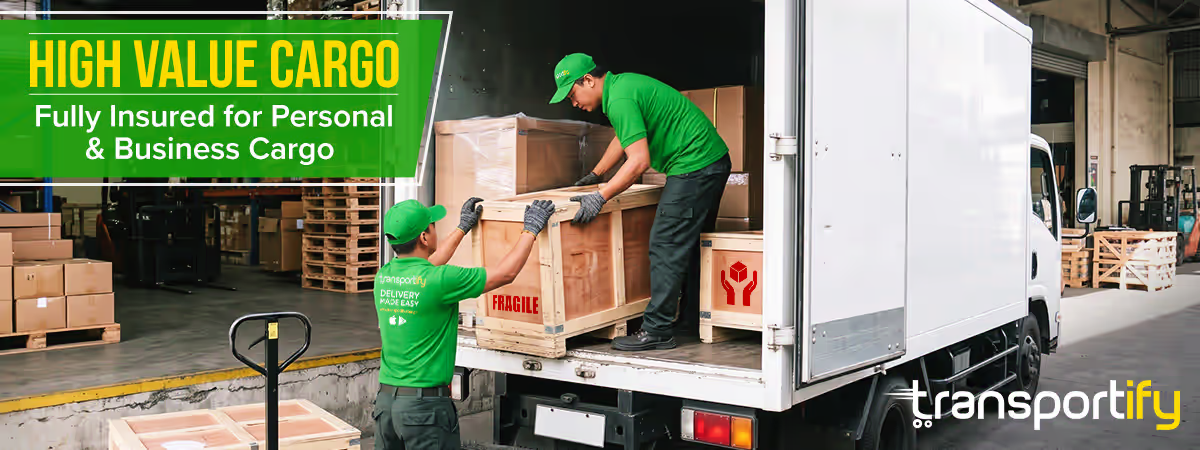
High value goods are shipments whose replacement cost is large enough that theft, or damage becomes a real business risk. Transportify is able to move high value goods across the Philippines with its real-time GPS tracking and provides insurance for every booking. High value shipments that Transportify accommodates range from glassware to heavy machinery. Our wide fleet selection ensures that each high value booking has an appropriate vehicle based on its size and weight. Corporate account holders have an added cargo insurance coverage of up to PHP 6,000,000 through OONA Insurance for shipments that need extra protection.
Delivery Options for Different Types of High Value Goods
Delivery options for different types of high value goods change based on the item’s size, fragility, and declared value. While there are many types of high-value goods, Transportify has the capability to handle them all. Transportify assigns a verified driver and items insurance to every booking to ensure the safety of your high value items. Learn more about Transportify’s delivery options for your type of high value goods.
High Value Electronics and Technology
High value electronics and technology shipments include laptops, desktop computers, professional broadcasting equipment, medical devices, and electronic office equipment. High value electronics and technological equipment benefits from an enclosed vehicle, starting from ₱220 Sedan which handles small packages to a closed van which handles a bulky delivery at ₱1,600 in Metro Manila. Choosing a vehicle here depends on the size and unit count.
Jewelry, Luxury Goods, and Collectibles
Jewelry, luxury goods, and collectibles cover items such as fine jewelry, designer accessories, and rare collectibles that carry both high monetary and sentimental value. Gold and pearl pieces, watches, designer bags, footwear, fragrances, boutique stock, art toys, trading cards, limited release sneakers, antiques, and coin collections are the common items. Small vehicles suit jewelry and luxury items, and Transportify’s Sedan at ₱220 in Metro Manila and MPV/SUV at ₱240 cover most of these bookings. A store restocking like replenishing supply of mall boutiques or setting up pop ups in events moves up the vehicle type by one class. A Light Van carries up to 600kg starting at ₱375 in Metro Manila.
Packaged or Unpackaged High Value Goods
Packaged or unpackaged high value goods refer to how the cargo arrives at pickup. Sealed retail cartons, palletized manufacturer stock, balikbayan boxes, wooden crates, hard flight cases, unboxed display units, and stripped machinery are the typical shipments. The vehicle class that is suitable for these types of cargo are L300/Van that starts at ₱415 and closed van that starts at ₱1,600 in Metro Manila. For a commercial bulky load, a 6-wheeler forward truck that starts at ₱4,450 or a wing van that starts at ₱7,000 are usually the choice.
Large and High Value Equipment
Large and high value equipment includes appliances and commercial machines that are too heavy or bulky for a van. Refrigerators, washing machines, commercial ovens, restaurant kitchen lines, gym apparatus, medical devices, server racks, generators, air compressors, and packaging machinery are the units that are common to ship in the large equipment category. Large equipment bookings start at the ₱1,600 Closed Van and rise to the ₱4,850 6w Fwd Truck and the ₱7,000 10W Wing Van in Metro Manila. Transportify’s Closed Van, Open Truck, 6w Fwd Truck, and Wing Van booking includes one extra helper in the base price.
Fragile and High Value Goods
Fragile and high value goods need extra padding and careful loading because a small impact can destroy the item’s entire worth. Glassware, artwork, delicate electronics, and other breakable or damage sensitive valuable goods make up the fragile category. Height and rigidity of an item are the factors of what vehicle type you’ll choose. A Sedan handles compact fragile items of up to 200kg starting at ₱220 in Metro Manila. An MPV/SUV takes taller pieces up to 300kg at ₱240. Gallery consignments and framed collections that need a sealed body book a Closed Van at ₱1,600 in Metro Manila.
High Value Commercial Cargo
High value commercial cargo covers bulk shipments that businesses move on a regular basis. Store replenishment stock, seasonal merchandise, office IT fleets, fit out fixtures, prescription medicines, medical consumables, diagnostic reagents, and distributor allocations are the common loads Philippine businesses ship. High value commercial cargo run on the three largest enclosed classes, at ₱1,600 for a Closed Van, ₱4,850 for a 6w Fwd Truck, and ₱7,000 for a 10W Wing Van in Metro Manila.
How does the High Value Goods Delivery Service work?
The high value goods delivery service works by entering trip details and specific delivery notes, choosing a vehicle type, and confirming proof of delivery. Transportify built this process around GPS tracking and items insurance attached to every booking.
- Enter the pickup and drop off details so the app can calculate the distance and return an itemized quote before anything is confirmed.
- Choose the appropriate vehicle and confirm the booking so the shipment is matched to an enclosed class with the right payload ceiling and the right insurance limit.
- Track the delivery and complete the proof of delivery so the shipment is documented from driver acceptance through signed handover at the final destination.
Transportify gives you a total peace of mind for every high-value shipment. Transportify offers standard vehicle-based insurance coverage and up to 6 million for corporate account holders.
Enter the Pickup and Drop-Off Details
Entering the pickup and drop-off details starts the booking process. Pickup and drop-off location is what determines both the price and the route the vehicle follows once it’s confirmed.
- Drop a pin on the pickup address, then add the building name, the unit or warehouse bay, and the gate or dock the driver should use for accurate loading.
- Add each drop-off point in the order the driver should visit them. A single booking holds up to 15 additional drop-off points.
- Attach a contact name and mobile number to every stop so the driver reaches the right receiver at each address.
Providing complete destination details decreases the chance of error when handing over the cargo.
Choose the Appropriate Vehicle and Confirm the Booking
Choosing the appropriate vehicle means comparing the options the app shows, since the vehicle options selected sets the payload ceiling and the insurance limit that applies to the shipment.
- Measure the largest single item in the shipment, since that figure decides which enclosed class actually fits it.
- Match that measurement to the smallest class that fits it: an L300/Van for loads up to 1,000kg, a Closed Van for 2,000kg to 5,000kg, a 6-wheeler forward truck for up to 7,000kg, or a 10-wheeler wing van for shipments up to 28,000kg.
- Confirm the booking once the vehicle is selected.
A driver-partner accepts shortly after, and that acceptance is what starts the shipment’s tracking window.
Track the Delivery and Complete the POD
Tracking the delivery starts the moment the driver accepts the job and continues until the shipment reaches its final stop.
- Open the booking in the app to see the driver’s live GPS position and the estimated arrival time.
- Message the driver directly in the app whenever something changes on the receiving end and contact 24/7 live customer service the same way if the issue needs a live agent.
- Complete the proof of delivery once the shipment arrives. The receiver signs digitally in the app. Additionally, corporate accounts can add the POD return service, where the booker hands a physical delivery receipt to the driver at pickup, the receiver signs it on arrival, and the driver returns the signed document to the booker.
That signed record, digital or physical, is what closes the booking and completes the chain of custody for the shipment.
High Value Goods Delivery Solutions for Every Team
High value goods delivery solutions address the different problems that arise from procurement, operations, facilities, and multi-branch teams run into when delivering cargo. A procurement team needs consistent restocking without tying up cash in extra inventory. A facilities team running several branches may need one booking that reaches every branch. An operations team may need a backup when a shipment falls through. Transportify’s Corporate Account ties these common problems and presents an all-in-one solution. Transportify’s on-demand booking system and a 24/7 customer service gives each team a way to solve their shipping problems.
Recurring Delivery Replenishment
Recurring delivery replenishment is a scheduled booking pattern that delivers a high value item, such as jewelry or electronics, to the same destination. Transportify’s corporate account lets a business save their pick up and drop off location and set up postpay monthly invoicing so it is easier for businesses to replenish their stock. Set up a Transportify corporate account to turn one-time high value deliveries into a dependable weekly replenishment schedule.
Multi Branch Distribution
Multi branch distribution is a single booking that carries high value goods from one warehouse to several branch locations in one trip. Transportify’s multi-stop feature can let a business add up to 15 extra destinations. Multi branch distribution fits operations and facilities teams that handle a lot of inventory across multiple store locations because it centralizes the cost and the tracking under one booking. Sign up for a Transportify’s corporate account and book a multi-stop delivery across all of your branches.
Same Day High Value Goods Delivery
Same day high value goods delivery is an immediate booking from pickup to drop-off within hours. A business facing an urgent or emergency restocking can always book through Transportify’s immediate delivery. Transportify dispatches a driver within roughly 60 minutes of booking and operates 24 hours a day, including holidays. Book a same day high value goods delivery through the Transportify app whenever your team needs a valuable item shipped right away.
High Value Goods Delivery Support
High value goods delivery support gives businesses a direct line to Transportify’s customer support whenever a shipment needs extra coordination, such as special handling instructions, or account-level troubleshooting. High value goods delivery support runs through an in-app live chat that lets a booker ask questions, report an issue, file a complaint, or cancel a booking and is backed by a 24/7 customer service line. Reach Transportify’s live support any time your high value goods delivery needs a hand.
Cheap Vehicle Options Per-Route Delivery Pricing
Choosing the right vehicle starts with matching the smallest enclosed vehicle class that clears the cargo dimension. Booking a class one size too big pays for a space the shipment never fills, and booking a vehicle too small can get you rejected upon pickup. Transportify prices each trip based on vehicle class, distance traveled, and the additional services that you availed for your booking.
L300 / Van Delivery
L300 and Van delivery ships up to 1000kg of high value goods in an 8 x 4.5 x 4.5 ft enclosed space. Pricing starts from ₱415 in Metro Manila, ₱374 outside Metro Manila, and ₱335 in Visayas and Mindanao. Its enclosed body keeps the high value goods shielded from rain and dust during the transit, and the small body of the vehicle lets you drive through subdivisions and other tight spaces.
Book an L300 or Van for your next high value goods run and get a verified driver dispatched within about 60 minutes.
Closed Van Delivery
Closed Van delivery carries 2,000kg to 5,000kg of high value cargo in a 10 to 14 x 6 x 6 ft sealed body. Pricing starts from ₱1,600 in Metro Manila and ₱1,450 outside Metro Manila and in Visayas and Mindanao. A 10-hour full day option is available as well starting at a flat rate of ₱6,000. One extra helper rides free with every Closed Van booking to load and unload alongside the driver. The fully enclosed cargo area protects fragile and high value goods from weather and road dust.
Book a Closed Van when your high value shipment outgrows a regular van, and get a free extra helper included.
6-Wheeler Forward Truck Delivery
6-wheeler forward truck delivery uses a mid-size truck around 18 by 6 by 7 feet that carries up to 7,000 kilograms. Pricing starts at PHP 4,850 across Metro Manila, areas outside Metro Manila, and Visayas and Mindanao. Transportify runs two configurations of this class: the Regular 6w Fwd Truck which opens at the rear, and the Wing-Van-Type which opens on the side for full-width access, and both include free waiting time of up to six hours per location plus one free Special Help and one free Extra Helper.
Book a 6-wheeler forward truck for bulk high value cargo for your business needs.
10-Wheeler Wing Van Delivery
10-wheeler wing van delivery moves 12,000kg to 28,000kg of high value cargo in a 32 to 40 x 7.8 x 7.8 ft body, priced from ₱7,000 in Metro Manila and ₱6,500 outside Metro Manila and in Visayas and Mindanao. 10-wheeler wing van side-opening doors give a forklift or the loading crew a full-width access to the cargo bed which can speed up the loading and unloading process.
Book a 10-wheeler wing van for your largest high value shipments and load the full space in one go.
What should customers do when a high value goods delivery encounters a problem?
Customers should act on a delivery problem the moment they notice it. A driver flags an issue from the road through the live booking screen, and a customer flags one from their end the same way, since both sides work off the same real-time record. A delayed pin on the map often just means heavy traffic or a longer loading time. If the delay stretches past the estimated arrival window, or if something looks off with the driver’s route, the next move is to message the driver directly through the Transportify’s app chat feature. Other issues like damaged items need a more formal process that starts with photos and a booking reference number.
What delivery issues can occur when transporting high value goods?
Delivery issues that occur when transporting high value goods are usually tied to timing, handling, and communication. Each delivery issue carries a different kind of risk for a valuable cargo.
- Delivery delays: Delivery delays are usually caused by traffic, weather, or an incomplete address, delays push back the pickup or drop-off window that the app originally quoted.
- Cargo damage: Cargo damage happens when fragile or heavy items shift during transit without enough padding or securing, and it shows up more often on longer provincial routes with rougher roads.
- Handling miscommunication: Miscommunication occurs when load notes about fragility or special care aren’t detailed enough, so a driver loads or stacks the item in a way the sender didn’t intend.
Most of the delivery issues trace back to how much handling detail gets entered at booking by the customer, since a driver can only protect what the app actually tells them to protect.
How can customers resolve problems that arise during delivery?
Customers can resolve problems that arise during delivery by acting fast and picking the right channel for the specific issue. An issue that surfaces while the shipment is still moving, such as a delayed driver or a wrong turn, gets flagged from the live tracking screen so a real-time agent can step in right away. An issue that surfaces after the shipment has already arrived, such as a damaged box or a missing item, goes through a different channel instead, since it needs documentation. Corporate accounts get an extra layer of support here, since Transportify assigns account managers who can step in directly. Waiting too long to report a problem can push a claim past its filing window and make it much harder to resolve.
Where can customers get help with a high value goods delivery issue?
Customers get help with a high value goods delivery issue through Transportify’s 24/7 customer service via mobile app or website. Customers can also reach the team by email at support@transportify.com.ph, or visit a local office in Pasig for a business matter that needs an in-person conversation.
Can customers report missing or damaged items after delivery?
Yes, customers can report missing or damaged items after delivery through Transportify’s claims process. A customer’s report needs to include the booking number, a clear description of what’s missing or damaged, and photos of the affected cargo, and it generally has to reach Transportify within 24 hours of the driver’s arrival at the drop-off point for standard bookings.
How can customers book a high value goods delivery with Transportify?
Customers can book a high value goods delivery by opening Transportify’s mobile app or the web app, entering the pickup and drop-off details, and confirming a vehicle that fits the cargo’s size. The system returns an itemized price before the booking confirms. Businesses that expect frequent high value shipments can skip re-entering details every time by setting up a corporate account with saved addresses and post pay invoicing instead.
What details are required to arrange a high value goods delivery?
Arranging a high value goods delivery requires a specific set of details that the app uses to match the shipment to the right vehicle and driver. Transportify’s booking collects all required information before showing the quotation.
- Cargo description and value: A short description of what’s being shipped, such as consumer electronics or jewelry stock, together with an approximate declared value, lets Transportify match the shipment to a vehicle class with an adequate insurance limit.
- Vehicle class: The booking needs a vehicle selected against the cargo’s weight and volume, from a Sedan for a small parcel up to a 10W Wing Van for a distributor-scale load.
- Stop-by-stop contact details: Every pickup and drop-off point needs a name and a working mobile number, since the receiver at each stop signs for the shipment digitally on the driver’s device.
- Extra service requirements: A customer flags any special help, extra helper, or extra space needed for the load before confirming, rather than requesting it once the driver has already arrived.
Completing these required details upfront ensures your high-value cargo is matched with the proper insurance coverage and vehicle capacity.
How can customers choose the right vehicle when making a booking?
Customers can choose the right vehicle by matching the cargo’s weight, size, and value to one of Transportify’s enclosed vehicles. A laptop or a small jewelry restock usually fits an L300 or a van, while a full pallet of retail inventory needs a closed van or larger. Heavier industrial loads can move up to 6-wheeler forward trucks or a 10-wheeler wing van. A customer who isn’t sure which vehicle class fits can enter the dimension of the cargo in the app and then let the system suggest a match before committing to one.
Can customers enter delivery requirements before confirming a booking?
Yes, customers can enter delivery requirements before confirming a booking. The app includes a field for load notes and special instructions, where customers can flag an item as fragile, request an extra helper for loading, or note handling steps a driver should follow like keeping a box upright throughout the trip. Adding this information before confirming the booking gives Transportify a documented record of the request that supports any claim filed later.
Can customers arrange a delivery for a specific schedule?
Yes, customers can arrange a delivery for a specific schedule, choosing an exact date and time up to two weeks ahead. The app lets customers pick a future date and time slot. Corporate accounts can take this further by setting up recurring schedules, so a weekly or daily replenishment run doesn’t need to be booked manually each time
What preparation is required before high value goods are collected?
Preparation for a high value goods collection means the shipment is packed, labeled, and staged at the pickup point before the driver’s estimated arrival window opens. A driver’s job is to transport the cargo safely. A well packed shipment survives loading, transit, and unloading with less risk of a helper mishandling it by accident. Skipping this step is one reason a claim gets denied later, since inadequate packing isn’t covered under Transportify’s warranty policy.
What packing requirements should be considered for high value goods?
Packing requirements for high value goods depend on the item’s fragility and size, but a few basics apply across almost every category.
- Rigid outer packaging: A hard box, crate, or flight case protects the shipment’s shape under the weight of other cargo stacked nearby, which matters most for electronics, appliances, and anything with a screen or a moving part.
- Interior cushioning: Foam, bubble wrap, or packing paper fills every gap inside the container so the item can’t shift, slide, or knock against the container wall during a hard stop or a sharp turn.
- Sealed and labeled boxes: Tape that holds under pressure, plus a visible label noting “fragile” or “this side up” when relevant.
Sturdy packaging, interior protection, and sealed boxes are the requirements that cover most of what the driver needs to see to load and secure an item correctly. preparation ensures your valuable goods arrive safely and in pristine condition at their final destination.
How can proper preparation help protect high value goods during transit?
Proper preparation protects high value goods during transit by giving the item enough physical buffer to survive normal road vibration and stacking against other cargo. A well packed box makes the driver’s job easier because a clearly labeled and properly sealed box is faster to load correctly the first time. Insufficient packing is explicitly listed as a non-covered cause under Transportify’s compensation policy.
Should fragile high value items receive additional protection before delivery?
Yes, fragile high value items should receive additional protection before delivery. Glassware, artwork, and delicate electronics benefit from extra cushioning layers, corner protectors, or a custom crate. Customers can also flag these items as fragile in the app’s load notes, which tells the driver to handle and stack that particular box with more care than the rest of the shipment.
Should high value goods be ready before the driver arrives?
Yes, high value goods should be ready before the driver arrives. Having the item sealed and positioned near the pickup point cuts down the loading time and reduces the chance of last-minute handling mistakes under time pressure.
How is high value goods delivery pricing determined?
High value goods delivery pricing is determined mainly by the vehicle type booked, the distance the shipment travels, and any additional services added on top of the base trip. Transportify’s app calculates all three automatically once a customer enters the pickup and drop-off details, so the price shown before confirming a booking already reflects the full cost.
What factors can affect the cost of transporting high value goods?
A handful of factors can affect the cost of transporting high value goods. Each factor moves the price independently, so a shipment can cost more or less even on the same route.
- Vehicle type: each vehicle class, from an L300 van to a 10-wheeler wing van, carries its own base rate tied to its size and weight capacity.
- Distance traveled: trips that go beyond the base coverage area add a per-kilometer charge on top of the flat base rate.
- Add-on services: extras like an additional helper, cash on delivery handling, or extra securing material such as rope or strapping raise the total beyond the base quote.
Vehicle type and distance affect the price the most on a standard trip. Meanwhile, Add-ons are the only part of the fare you choose.
How does delivery distance influence the overall price?
Delivery distance influences the overall price by adding a per-kilometer charge once a trip goes past the base coverage radius included in a vehicle’s flat rate. Every vehicle type comes with a starting price that already covers a set distance range. A short intracity delivery within a few kilometers of the pickup point often costs close to the base rate alone. Past the covered radius, a per-kilometer charge scales with the extra distance. Choosing a slightly smaller vehicle for a long-distance run rarely saves money if the cargo doesn’t actually fit, since a mismatched vehicle can mean multiple trips instead of one.
Does the selected vehicle affect the total delivery cost?
Yes, the selected vehicle affects the total delivery cost, since each vehicle class carries its own base rate. A Sedan starts at ₱220 in Metro Manila for a small high value parcel, while a 10W Wing Van starts at ₱7,000 for a distributor-scale load. Choosing a class one size larger than the cargo needs adds cost because you’re playing for a capacity the shipment never uses.
Can additional delivery requirements increase the price?
Yes, additional delivery requirements can increase the price, depending on what those requirements actually involve. Requesting extra rope or strapping to secure an item and adding a second helper for heavy loading all come with their own line-item cost on top of the base fare. Multiple drop-off points add a per-stop fee as well. The app shows the updated total price before a customer confirms the booking.
What happens after a high value goods delivery is booked?
After a high value goods delivery is booked, Transportify assigns a verified driver and vehicle. Then, the driver heads to the pickup point and the shipment moves through a defined chain of custody until it reaches the final drop-off address. Driver matching starts as soon as the booking is confirmed.
How are high value goods handled from collection through final delivery?
High value goods are handled from collection through final delivery under a structured process that starts the moment the driver arrives at the pickup point. The driver inspects the cargo alongside the sender, confirms the item matches what was declared in the booking, and loads it according to the handling notes entered during booking. Once loaded, the cargo stays with that same driver and vehicle for the entire trip, without transferring to another vehicle mid-route. At the final stop, the receiver inspects the item before signing off, which closes the chain of custody and confirms the condition of the goods at handover.
What factors can affect the progress of a high value goods delivery?
A few recurring factors can affect the progress of a high value goods delivery once it’s already underway, and most of them are outside the driver’s direct control.
- Traffic and road conditions: congestion, road closures, or construction along the route can push back the estimated arrival time.
- Weather disruptions: heavy rain or flooding can slow a trip significantly, especially on provincial routes with fewer alternate roads.
- Last-minute changes: an added stop, a locked gate at drop-off, or a receiver who isn’t available yet can extend the delivery beyond its original window.
Most delays trace back to conditions on the road rather than anything inside Transportify’s process, which is exactly why live tracking is important for a high value shipment.
Can customers receive delivery updates while goods are in transit?
Yes, customers can receive delivery updates while goods are in transit. The app shows the driver’s live location on a map along with a running estimated time of arrival, and customers can message the driver directly if they need a status check beyond what the map already shows. The live view stays active from the moment the driver accepts the booking until arrival at the final destination.
Can delivery arrangements be adjusted when circumstances change?
Yes, delivery arrangements can be adjusted when circumstances change, as long as the booking hasn’t already been confirmed with a driver or moved into transit. Customers can edit details like the drop-off address, contact information, or schedule while the booking is still in an editable state, and the app will recalculate the price if those changes affect distance or vehicle requirements. Once a driver has been dispatched and the cargo is already loaded, though, changes need to go through customer service instead of the booking screen, since the trip is already committed to its original route.
What policies govern high value goods deliveries?
Transportify’s high value goods deliveries are governed by the Customer Account Terms of Use. Customer Account Terms of Use covers cancellations, refunds, claims, and what happens when cargo is lost or damaged in transit. Coverage limits and exclusions differ by cargo and account type. The two sections that matter most cover cancellations and changes, and loss or damage.
What rules apply when cancelling or modifying a delivery?
A few clear rules apply when cancelling or modifying a delivery, and most of them center on timing.
- Cancellation fee: last-minute cancellations carry a fee equal to 30% of the total logistics service fee quoted for that booking.
- Price recalculation: modifying booking details like distance or cargo weight after confirmation updates the price, and the customer must accept the new total before the trip proceeds.
- Dispatch cutoff: once a driver is assigned and en route, changes to the pickup or drop-off point typically require contacting customer service rather than editing the booking directly.
The 30% cancellation fee is the detail most customers overlook, and it’s exactly why locking in accurate pickup details early avoids an unnecessary charge later.
How are refunds handled when a delivery is cancelled or cannot be completed?
Refunds for a cancelled or incomplete delivery go through Transportify’s customer service team rather than an automated in-app process. A customer requests the refund by reaching out through live chat or email, referencing the booking number, and customer service reviews whether a cancellation fee applies based on the timing of the cancellation. If a delivery can’t be completed for reasons outside the customer’s control, such as a vehicle breakdown or a vendor issue on Transportify’s end, the refund review typically moves faster since the 30% last-minute fee is meant for shipper-initiated cancellations
Can customers request a refund after cancelling a delivery?
Yes, customers can request a refund after cancelling a delivery, but a cancellation fee applies for last-minute cancellations. The fee equals 30% of the total logistics service fee quoted for the booking, and it’s due from the shipper to the carrier as part of the standard cancellation terms. Cancelling with enough lead time before the scheduled pickup generally avoids this fee altogether.
Can customers submit a claim for high value goods damaged during delivery?
Yes, customers can submit a claim for high value goods damaged during delivery, and Transportify’s terms formally recognize this as a value-added service covering loss, damage, or destruction that happens during the cargo’s Period of Transportation. Every booking includes complimentary incidental goods insurance with standard limits capped at PHP 75,000, while corporate accounts carry a higher limit of up to PHP 6,000,000.







 Chat