



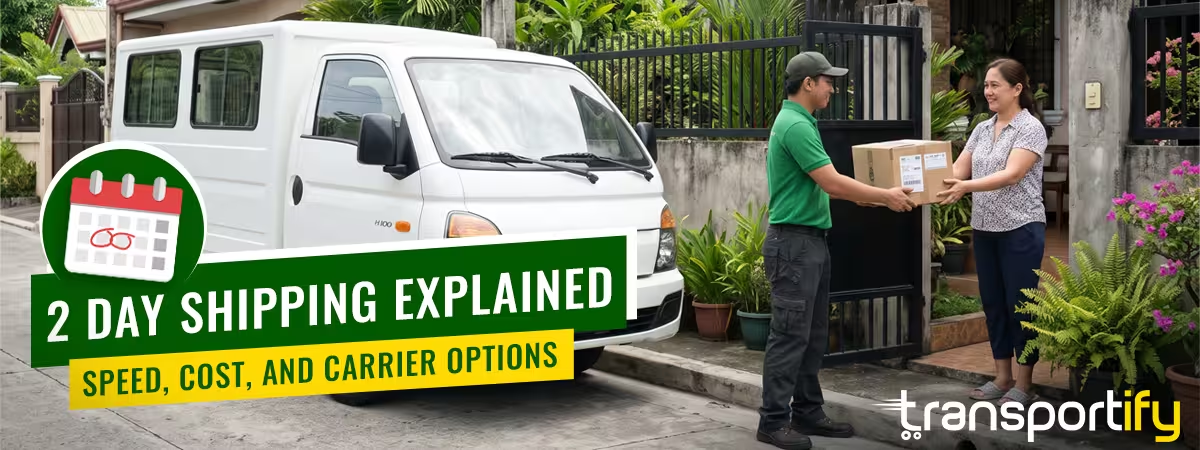
Two-day shipping is a delivery method that moves an online order to the buyer within two business days of order processing. Two-day shipping sits between slower standard delivery and premium same-day service. Two-day shoppers get their parcels fast enough to stay satisfied, and sellers keep fulfillment costs lower than of same-day couriers.
Two-day shipping for a business works as a lever for speed, cost, and customer trust. Filipino buyers weigh local sellers against global marketplaces, so a two-day window often decides whether a sale is converted. Baymard Institute research links about 21% of cart abandonment to slow delivery.
What is Two Day Shipping in Ecommerce Delivery Systems?
Two-day shipping in ecommerce is a logistics service that delivers a customer’s order within 48 business hours after the order finishes processing. Two-day shipping processing starts once the warehouse confirms and packs the order. Two-day shipping counts working days, and excludes weekends and Philippine holidays unless stated otherwise.
The two-day service depends on closeness of the inventory to the buyer, the daily carrier cutoff, and if the order travels through an express lane. In the Philippines, that express lane often means air cargo between, because the country’s numerous islands make ground-only two-day delivery hard across regions. Domestic couriers such as publish two-day and next-day tiers that ecommerce platforms plug into at checkout.
Two-day shipping earns its place because buyer expectations have shifted. Roughly 74% of online shoppers now expect delivery within two days, based on ecommerce studies compiled by Opensend, and Filipino buyers increasingly hold local stores to that same standard. A seller offering the service tells the customer, in plain terms, that the order will move within a fixed, countable window.
What are the Costs of Offering Two Day Shipping in Ecommerce?
The costs of offering two-day shipping in ecommerce cover every expense a seller pays to move an order fast and on time. Understanding the costs of two-day shipping allows sellers to make informed decisions on whether to offer the service or not.
- Carrier fees: The payments to couriers for express pickup and delivery. Carrier fees scale with distance, package weight, and speed tier.
- Warehousing costs: The rent and storage charges for holding stock in regional fulfillment centers close to buyers. Positioning inventory near demand shortens transit time, but incurs cost from the number of facilities a seller pays for.
- Packaging costs: The spending for boxes, fillers, labels, and protective materials that keep parcels intact during handling. Handling has a risk of damaging the cargo so sellers are inclined to purchase package protection.
- Operational overhead: The Labor, technology, and coordination expenses from the shipping process.
Carrier fees and warehousing usually account for the largest share of the total two-day shipping cost. A seller needs to find the balance between investing in faster transit time and the associated costs in achieving expedited shipping times.
What are Carrier Shipping Costs in Two Day Delivery
Carrier shipping costs in two-day delivery refer to the premium pricing charged by logistics providers for the expedited delivery. Carriers charge premium rates because guaranteed two-day windows require priority handling and dedicated sorting lanes. Philippine domestic couriers have expedited and two-day tiers 1.5 to 2.5 times higher than standard rates. Sellers offering two-day shipping nationwide should expect carrier costs to vary sharply between Metro Manila zones and interisland destinations, since the added transport leg is what drives most of the price gap.
What are Warehouse and Fulfillment Costs in Two Day Shipping?
Warehouse and fulfillment costs in two-day shipping are expenses for storing inventory across regional fulfillment centers. A warehouse in Manila cannot reliably fulfill a 48-hour window for Cebu, hence the need for sellers to have a storage area in Cebu and other major hubs in the country to fulfill two day shipping windows. Multiplying inventory across regional centers increases carrying costs and complicates stock forecasting, since each hub needs its own buffer stock to avoid stockouts during demand spikes.
What are Packaging and Handling Costs in Fast Delivery Systems?
Packaging and handling costs in fast delivery systems are the expenses of preparing an item for rapid shipment. These costs scale directly with volume as each order incurs its own packaging and handling cost.
- Packaging materials: Boxes, mailers, tape, labels, and cushioning that protect a product in transit.
- Labor: Wages for the staff who pick, pack, and label orders against a tight cutoff.
- Speed-optimized handling processes: Workflows, equipment, and station layouts built to pack orders in less time.
Small savings per order compound because the costs are attached to every order. The tradeoff with savings is cargo protection and fulfillment risk. Too much cost-cutting increases the risk of an item being damaged or not being delivered in the promised delivery window.
How does Shipping Insurance Work in Two Day Shipping?
Shipping insurance protects sellers and buyers against loss or damage during transit. Shipping insurance is based on the declared value of the item. The declared value sets the maximum a claim can pay. Policies on how much of the declared value is insured differs from carrier to carrier. Typical shipping insurance is usually availed by the shipper when booking a shipment and may differ depending on the item type, such as insurance for gadgets.
Carrier liability is a concept adjacent to shipping insurance. Carrier liability is the carrier’s responsibility to compensate the shipper for loss or damage for which it is legally responsible. Applicable law and the shipping agreement determine how much the carrier owes. A declared-value arrangement may increase that limit, but doesn’t automatically provide insurance or guarantee full reimbursement. Shipping insurance offers separate financial protection for covered losses and may cover events beyond the carrier’s responsibility. The policy’s terms determine the payout, including any exclusions or deductible.
What is Covered Under Shipping Insurance for Ecommerce Orders?
Coverage under shipping insurance for ecommerce orders is financial protection during shipment that reimburses a seller or buyer when a parcel is damaged or missing. Philippine sellers running a two-day shipping line need to know exactly which failure points a policy responds to.
- Loss protection: Covers parcels that go missing entirely during the delivery process. Payouts are based on the declared value of the item, up to the policy’s maximum limit.
- Damage reimbursement: Encapsulates items that arrive broken, crushed, or otherwise unusable due to mishandling in transit. Most Philippine carriers require photo evidence submitted within 24 to 72 hours of delivery to process this claim.
- Delivery failure compensation: This covers cases where the parcel is confirmed stolen, misdelivered, or otherwise never reaches the intended recipient despite tracking showing movement.
A two-day shipment that arrives late but intact typically falls outside standard shipping insurance, which is why sellers still need separate delivery-guarantee policies or service-level agreements with their carrier to protect against missed timeframes.
Is Shipping Insurance Necessary for Ecommerce Businesses Offering 2 Day Shipping?
Yes, shipping insurance is necessary for ecommerce businesses offering two-day shipping. Two-day shipping’s faster delivery raises parcel volume and the number of handling points where loss or damage can occur. Shipping insurance adds a layer of protection for the customer which is especially important due to the higher risk of damage.
How is Delivery Managed in Two Day Shipping Logistics?
Delivery in two day shipping logistics can be managed by planning each stage of the parcel’s trip before the order arrives. Start with identifying regional warehouses near your main buyer clusters. Ship each order from the facility closest to the buyer. Shorter ground distance leaves more time for every later stage. The next step is to set up optimized routing systems. Group parcels by delivery zone. Assign each group to the carrier lane that fits the 48-hour limit. Use air cargo for interisland orders that ground routes can’t cover in time. After route optimization, turn on real-time tracking from pickup to delivery to monitor for stalled parcels. Finish with last-mile carrier coordination on every final handoff. Confirm pickup and delivery schedules in advance. Brief riders on hard-to-reach addresses.
Why does Two Day Shipping Improve Ecommerce Customer Experience?
Two-day shipping improves ecommerce customer experience because faster, predictable delivery raises buyer satisfaction. Delivery speed and predictability shape whether a buyer returns. Speed shortens the waiting time and predictability tells the buyer exactly when the order arrives. A recent article published by International Research Journal of Education and Technology surveyed 260 shoppers and found that satisfaction depends on how closely delivery matches what the buyer expected. A dependable two-day window builds trust with Filipino shoppers and increases the likelihood of returning.
How can Ecommerce Businesses Lower Expenses While Offering Two Day Shipping?
Ecommerce businesses can lower expenses while offering two-day shipping by shortening the distance each parcel travels and cutting waste in fulfillment. One way of accomplishing this is keeping inventory stock close to buyers by distributing products across different regional hubs. Businesses can also try carrier negotiation to lower the rate per parcel. Businesses that high order volumes can leverage bigger discounts with their carrier. Cutting waste can be accomplished by automation which helps optimize labor time and reduce errors. Automation such as the use of an order management software and barcode scanning makes sorting and packing faster and more accurate.
What are the Risks of Offering Two Day Shipping in Ecommerce?
The risks of offering two-day shipping in ecommerce are operational and financial challenges that appear when a fast delivery promise is inhibited by real-world conditions. The Philippine’s characteristics including its geography and weather contributes to the risk.
- Delays: Push parcels past the 48-hour window when weather or carrier capacity limits slow transit. A single missed interisland flight can break the promise and trigger refund requests.
- Higher logistics costs: Raise spending on express lanes and rush handling that slower services avoid. Two-day delivery on low-margin orders can turn a profitable sale into a break-even one.
- Inventory misalignment: LeaveS stock in the wrong zone that causes prolonged delivery time.
- Insurance claim exposure: Increase the number of loss and damage claims as faster handling adds pressure on staff.
Sellers are recommended to audit their regional coverage and carrier reliability before advertising a two-day guarantee to avoid absorbing the costs incurred by these losses.
How does Two Day Shipping Compare in Cost Versus Standard Delivery?
Two-day shipping costs more than standard delivery because it prioritizes delivery within two business days which needs additional operational resources. The price difference varies with parcel size, weight, distance, and service coverage. The gap in price between the two shipping methods is due to infrastructure. Standard delivery can route a parcel through a regional sorting hub over several days without missing its delivery promise. A two-day guarantee forces the same parcel through dedicated processing lanes, tighter cutoffs, and potentially air cargo space for interisland shipments.
How does Same Day Shipping Compare to 2 Day Shipping?
Same-day shipping compared to two-day shipping is a faster and more premium service, since it dispatches an order within the day rather than a 48-hour window. Same day shipping runs on immediate and localized dispatching. The seller sends each order to an on-demand rider soon after the cutoff time. Same day shipping, compared to two day shipping, is more reliant on the proximity of the dispatch location to the customer. Two-day shipping has more flexibility to run on expedited transit across regions due to the wider window. The trade-off for a faster delivery through same-day shipping is at the cost of lower coverage for the service.
What Operational Trade-Offs Differentiate Same Day Routing From 2 Day Shipping?
The operational trade-offs that differentiate same-day routing from two-day shipping are the practical costs and limits a seller accepts to deliver within hours. Same-day speed forces tighter constraints at every step. Two-day shipping can also be subject to tighter constraints but at a lesser degree than same-day shipping.
- Extreme cost premiums: Same-day delivery charges more than two-day service because of higher operational costs to compress the delivery timeline.
- Tight facility processing cut-offs: Same-day services have narrow daily windows to pack and dispatch compared to two-day. A missed cut-off pushes the order to the next day, so same-day has minimal leeway for batch processing that two-day fulfillment allows.
- Localized vehicle constraints: Same-day routing often relies on light vehicles suited to dense urban traffic, which caps same-day network expansion. Two-day shipping uses a mixed fleet across trucks, vans, and air cargo.
The trade-offs for same-day explain why the service is difficult to scale, since cost, timing, and vehicle limits tightens as the fulfillment window is reduced to a day. Two-day shipping loosens the constraints at the cost of an added day of transit.
How can Retailers Maintain a Sustainable Two Day Fulfillment Pipeline?
Retailers can maintain a sustainable two day fulfillment pipeline by matching its logistics scale to order volume. Start with checking if daily orders are high enough to fill regional warehouses and earn carrier discounts. Phase in two-day coverage region by region as volume grows. The next step is to spread stock across warehouse hubs near your buyers. Local stock lets most orders travel by ground within 48 hours, so you avoid costly last-minute air freight. After that, tighten operational efficiency. Use demand forecasting to stock each hub for its local market. Automate order processing. Keep inventory data clean to cut stockouts and reshipments.







 Chat