



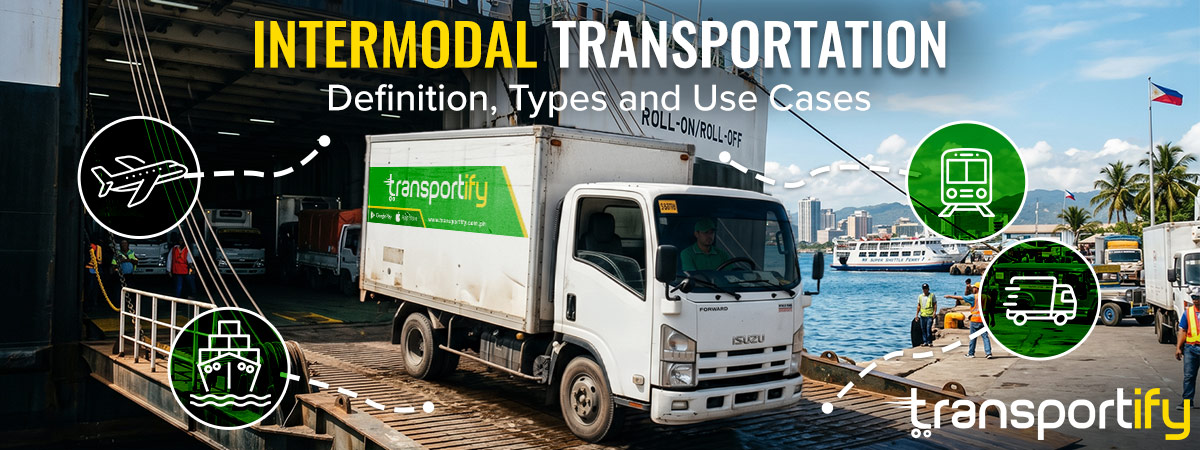
Intermodal transportation is the movement of goods using two or more transport modes within a single logistics journey. Intermodal transportation operations don’t directly handle the cargo when transferring between transport modes. The intermodal cargo stays inside a standardized container throughout the entire shipment. Only the cargo container moves between trucks, trains, ships, and aircraft at each transfer point.
The approach of intermodal transportation eliminates repeated loading and unloading of individual goods to reduce handling damage, cut transit time, and lower labor costs across long-distance and cross-border supply chains. Intermodal transportation enables manufacturers, distributors, and retailers to move cargo efficiently across continents and between islands without treating each transport leg as a separate shipment.
The Philippines relies heavily on intermodal transportation because of its archipelago geography. Shipping carries approximately 99% of all inter-island cargo in the country. Road, sea, and rail systems must work together to keep domestic and international goods moving. Transportify supports the country’s intermodal network by offering inter-island delivery services using trucks and Roll-on, Roll-off (RoRo) ships. Transportify’s interisland services connect Luzon to Visayas and Mindanao destinations through a single booking on the Transportify platform.
What is Intermodal Transportation?
Intermodal transportation is a logistics model where goods travel inside a single standardized container across multiple transport modes including road, rail, sea, and air. Intermodal transportation’s standard containers are the constant unit of cargo across the multiple transport modes. Standardized containers allow for seamless mode transitions without unpacking or rehandling the freight inside. The defining characteristic of intermodal transport is the separation between the cargo and the vehicle. The cargo unit remains unchanged while the transport mode changes around it at each node in the network.
The standardized container used in intermodal transportation fits a truck chassis, a railcar flatbed, a container ship, and an airport cargo hold. Container dimensions follow International Organization for Standardization (ISO) specifications. ISO compliance is what makes intermodal transportation work across different carriers, ports, and countries. This container-centric architecture separates intermodal transport from traditional multi-leg freight arrangements. Traditional shipping unpacks and repacks cargo between vehicles at every mode change. Intermodal transportation removes the repacking step entirely.
How Does Intermodal Transportation Work in Logistics Systems?
Intermodal transportation works in logistics systems by starting with placing the cargo inside a standardized container at origin in a process called containerization. The standardized container with the cargo is then moved through a series of transfer nodes that each connects a transport mode to the next. The whole intermodal transportation process involves coordinated freight movement to keep the full chain on schedule
Containerization involves packing cargo into ISO-compliant containers. Common ISO-compliant containers include 20-foot (TEU) or 40-foot (FEU) units, at the shipper’s facility. A truck picks up the sealed container and delivers it to the first transfer node.
Transfer nodes are the interchange points where a container moves from one transport mode to the next. Transfer nodes include seaports, railroad terminals, inland container depots, and air cargo facilities. Cranes or lift equipment move the container from one vehicle or vessel to another. No unpacking happens at every transfer node.
Coordinated freight movement across modes requires a single logistics record that tracks the container through every leg. Digital freight management systems assign a unique container identification number to track the shipment status in real time. The integration of port community systems in the Philippines at major ports like Manila, Cebu, and Davao with truck booking systems and rail-linked logistics corridors is gradually building the digital layer that makes intermodal coordination more reliable and transparent for shippers.
Is Shipping Insurance relevant for intermodal transportation shipments?
Yes, shipping insurance is relevant for intermodal transportation shipments. Each mode transfer is a point where handling risk increases. A container moving from a vessel to a crane to a rail flatcar to a truck encounters more mechanical contact and more potential for mishandling than a single-mode shipment. Standard carrier liability under intermodal contracts is capped at low per-kilogram rates that do not reflect the actual value of the cargo. Intermodal shippers carrying electronics, pharmaceuticals, or high-value goods carry significant uninsured financial exposure without a separate cargo insurance policy. Cargo insurance In the Philippines covers gaps in carrier liability that neither the trucking company nor the shipping line is contractually required to fill for routes that combine road transport with RoRo shipping.
What are the other Types of Transportation?
The other types of transportation used in logistics are road, rail, air, sea, and pipeline transport. Each type serves a distinct freight profile based on cargo volume, delivery urgency, distance, and cost. Shippers that understand the other types of transportation choose the right mode or combination of modes for their specific logistics needs.
- Road transportation: Moves goods via trucks, vans, and motorcycles along road and highway networks. Road transportation is the most flexible transport type in the Philippines because it provides direct door-to-door delivery without requiring cargo transfers at terminals. Land freight handles domestic last-mile distribution for both small parcels and full truckload shipments.
- Rail transportation: Moves bulk or heavy goods using trains along fixed railway tracks. Rail transportation costs less per kilometer than road transport and produces lower carbon emissions per ton of freight. Rail freight is not yet widely operational for cargo in the Philippines, though the government has committed to expanding rail infrastructure under the Build Better More (BBM) program.
- Air transportation: Moves time-sensitive or high-value goods via cargo aircraft. Air transportation is the fastest freight type available but also the most expensive per kilogram. Philippine exporters use air freight for perishables, electronics, and pharmaceutical cargo that cannot tolerate sea transit times.
- Sea transportation: Moves large cargo volumes using container ships, bulk carriers, and RoRo vessels across oceans and inter-island routes. Sea transportation costs less per unit than any other mode and handles the highest cargo volumes globally. In the Philippines, sea transport carries majority of all inter-island freight.
- Pipeline transportation: Moves liquid and gas products such as oil, fuel, and natural gas through fixed underground or overground pipes. Pipeline transportation is not used for general cargo logistics. Pipeline transportation serves the energy sector exclusively, connecting refineries, storage facilities, and distribution terminals.
Each transportation type has a defined role in the logistics ecosystem. None of the other transportation types operates in complete isolation from the others in a functioning supply chain. Intermodal transportation exists precisely because no single transport type handles every distance, cargo category, and cost requirement equally well.
Why Is Intermodal Transportation Important in Global Supply Chains?
Intermodal transportation is important in global supply chains because it reduces total freight cost, increases capacity utilization, and enables trade flows across distances that no single transport mode can cover efficiently on its own. Intermodal transportation cuts freight costs by up to 40% on long-haul routes compared to road-only shipping. Rail is three to four times more fuel-efficient than trucks for long-distance hauls, and a single train crew can move the equivalent of dozens of truck loads.
Intermodal transportation lets businesses increase or decrease cargo volume without rebuilding their logistics infrastructure. Container standardization makes it possible to add rail legs, swap sea routes, or extend truck coverage without renegotiating entire supply chain contracts.
Intermodal transportation also enables international trade integration for the Philippines. The Philippines’ logistics costs consume 27.5% of the country’s gross domestic product (GDP) according to the Management Association of the Philippines. Intermodal transportation directly addresses that gap by removing redundant handling steps between ports, roads, and distribution centers. Philippine transport stakeholders have also called for full implementation of the ASEAN Framework Agreement on Multimodal Transport (AFAMT) to position the country as a competitive logistics hub in Southeast Asia by 2030.
What are the Challenges of Trucking Services in Intermodal Transportation?
The challenges of trucking services in intermodal transportation include coordination complexity, infrastructure dependency, longer transit times, and scheduling risks. Trucking services are responsible for first-mile pickup and last-mile delivery of every container movement which increases its potential to disrupt the intermodal chain.
- Coordination complexity: Trucking services must synchronize pickup and delivery windows with fixed rail and vessel departure schedules. A single missed window cascades into delays across every subsequent leg of the intermodal journey.
- Infrastructure dependency: Trucking services in intermodal networks depend on road access, container yard capacity, chassis availability, and rail connectivity. Congestion or infrastructure gaps at any point in intermodal transportation slows delivery time and increases cost.
- Longer transit times: Intermodal trucking legs are coordinated around fixed rail and vessel schedules rather than direct point-to-point routes leading to longer total transit times that exceed those of a direct truck delivery.
- Scheduling risks: Last-minute cargo volume changes, truck breakdowns, or driver shortages at the trucking leg create cascading delays across the intermodal chain since rail and sea legs cannot wait for individual late arrivals.
Businesses have to plan and work with reliable trucking services partners who have direct access to intermodal terminals to minimize the challenges faced by trucking legs.
Is OTR Trucking applicable to Intermodal Logistics Operations?
Yes, OTR trucking is applicable to intermodal logistics operations. The primary connector between intermodal nodes and final delivery destinations is OTR trucking. OTR trucking services handles the first-mile leg by moving loaded containers from a shipper’s facility to a port or rail ramp. OTR handles the last-mile leg by delivering containers from a rail terminal or distribution center to the consignee. Businesses that combine OTR trucking with rail and sea modes can balance cost and transit speed by reserving OTR exclusively for time-sensitive cargo segments while using lower-cost rail and sea legs for the long-haul portions.
What Are the Main Types of Intermodal Transportation?
The main types of Intermodal transportation are rail-truck, ship-truck, rail-ship, air-truck, air-rail and multi-leg. Each type of intermodal transportation is defined by a combination of transport modes used across a shipment’s journey. The right combination depends on distance, cargo type, infrastructure access, cost targets, and delivery urgency.
- Rail–Truck (Road–Rail Intermodal): Pairs the long-haul efficiency of rail with the flexibility of truck drayage for first- and last-mile delivery. Rail-truck transportation is the most widely used intermodal combination globally,
- Ship–Truck (Ocean–Road Intermodal): Combines container shipping with road transport. Ship-truck intermodal handles most of the Philippines’ international import and export freight.
- Rail–Ship (Ocean–Rail Intermodal): Moves cargo inland by rail before loading onto a vessel. Rail-ship intermodal is suited for high-volume export corridors where inland rail infrastructure exists.
- Air–Truck (Air–Road Intermodal): Routes time-critical cargo through air freight hubs. Truck drayage completes the final delivery to the consignee.
- Air–Rail Intermodal: Transfers cargo from an airport directly to a rail network for inland distribution. Air-rail intermodal balances speed and cost for high-value shipments over medium distances.
- Multi-leg Intermodal (3+ modes combined): Chains three or more modes into a single containerized journey. Examples of common multi-leg intermodal journeys include truck–rail–ship or truck–ship–truck, for complex cross-border supply chain routes.
Every type of intermodal transportation uses the same sealed container across all legs. The right intermodal type depends on the cargo’s delivery urgency, weight, and the available transport infrastructure at origin and destination. Ship-Truck intermodal in the Philippines is the most operationally critical combination because of the country’s island geography and dependence on seaport connectivity.
1. Rail–Truck (Road–Rail Intermodal)
Rail-truck intermodal is a freight model where a truck picks up a sealed container and delivers it to a rail terminal. The rail-truck container is loaded onto a flatcar for a long-haul rail movement before a second truck handles the final delivery. Rail-truck IS the most commercially dominant intermodal combination in freight logistics as it holds a 45.8% revenue share among all intermodal types globally.
The rail leg significantly reduces fuel costs compared to full road transport. Rail-truck intermodal is effective for domestic shipments spanning more than 500 kilometers. Planned rail freight revival projects under the National Transportation Policy in the Philippines aim to extend rail-truck intermodal capability to key industrial corridors connecting Luzon manufacturing zones to port facilities.
2. Ship–Truck (Ocean–Road Intermodal)
Ship-truck intermodal is a freight model where a truck delivers a container to a seaport. A container vessel carries the container across an ocean or inter-island sea route. Another truck receives the container at the destination port for final delivery. Ship-truck intermodal is the backbone of Philippine domestic and international logistics.
Ocean freight handles the high-volume, long-distance leg at the lowest cost per unit. The truck leg of ship-truck intermodal provides the flexibility needed to reach inland destinations that vessels can’t directly access. Ship-truck intermodal is the default intermodal model used by freight forwarders for businesses exporting from the Philippines to international markets. For businesses needing inter-island ship–truck coverage across Luzon, Visayas, and Mindanao, Transportify’s interisland trucking service handles the truck leg on both ends of the RoRo vessel. Transportify’s interisland offers door-to-door cargo movement without the need to coordinate separate carriers at each port.
3. Rail–Ship (Ocean–Rail Intermodal)
Rail-ship intermodal is a freight model where a train moves a container from an inland location to a coastal seaport. The rail-ship container is then transferred onto a vessel for the ocean leg of the journey. Rail-ship intermodal reduces the truck volume on port access roads because rail can deliver large numbers of containers to a port terminal in a single scheduled movement instead of individual truck trips.
Rail-ship intermodal is important for landlocked manufacturing regions that need reliable, high-volume access to export ports. While the Philippines currently has limited freight rail infrastructure, Rail-ship intermodal remains a relevant model for Philippine logistics planners as the country pursues freight rail development under its long-term transport infrastructure agenda.
4. Air–Truck (Air–Road Intermodal)
Air-truck intermodal is a freight model where a truck collects cargo from the shipper and delivers it to an airport cargo terminal. An aircraft carries the cargo across a long international or domestic distance. A truck at the destination airport handles delivery to the final consignee.
Air-truck intermodal serves high-value, time-sensitive, and perishable cargo that can’t absorb the longer transit times of sea or rail. Industries that rely on air-truck intermodal include electronics, pharmaceuticals, fashion, and fresh produce. Air-truck intermodal in the Philippines supports export shipments out of the Ninoy Aquino International Airport (NAIA) and Mactan-Cebu International Airport. Trucks manage the collection from production facilities to the cargo terminal.
5. Air–Rail Intermodal
Air-rail intermodal is a freight model where an aircraft covers a fast international or long-distance leg. The container is then transferred to a rail system for cost-efficient inland distribution to the final destination. Air-rail intermodal balances speed and cost by using air only where distance or urgency demands it. Air–rail transport shifts to the lower-cost rail mode for the inland leg.
Air intermodal is useful for international shipments that need to move large volumes rapidly across borders but where the destination region has strong rail connectivity to distribution centers. Air-rail intermodal is currently less common in the Philippines given the developing state of domestic freight rail. Air-rail combinations are relevant for Philippine exporters routing cargo through major Asian hub airports connected to rail freight networks in Japan, South Korea, and mainland China.
6. Multi-leg Intermodal (3+ modes combined)
Multi-leg intermodal is a freight model where a container travels across three or more transport modes in sequence within a single coordinated shipment plan. Multi-leg intermodal examples include truck to rail to ship, or truck to ship to truck to rail,. Multi-leg intermodal is the most operationally complex intermodal type because every additional mode change introduces another transfer node.
Multi-leg intermodal is a powerful model for intercontinental trade because multi-leg intermodal lets logistics planners string together the cost-efficient modes available for each geographic segment of a journey. A common multi-leg intermodal route for Philippine businesses exporting to Europe or North America involves truck pickup from a Luzon factory, RoRo vessel transfer to a main island port, container ship ocean leg to a hub port, and rail or truck distribution at the destination country.
Can a Transport Management System be used in an Intermodal Transportation?
Yes, a transport management system (TMS) is essential for managing intermodal transportation effectively. Intermodal operations involve multiple carriers, modes, handoff points, and document sets that cannot be reliably coordinated through manual processes. A transport management system provides a single platform for route optimization, carrier scheduling, real-time container tracking, and exception alerts across every leg of an intermodal chain. A TMS reduces the coordination gaps between trucking, rail, and ocean operators that cause delays and cost overruns.
How Does Containerization Enable Intermodal Transportation?
Containerization enables intermodal transportation by establishing a single standardized cargo unit that any transport mode can load and transfer without unpacking the cargo inside.
The ISO shipping container was standardized between 1968 and 1970 by the International Maritime Organization (IMO). The IMO defined fixed dimensions, structural strength, corner casting positions, and weight tolerances for containers to serve as a guide worldwide. Up to 95% of intermodal containers in global use comply with ISO standards.
Cargo moved as break-bulk freight before containerization. Break-bulk freight required manual loading and unloading at every mode change. The break-bulk process added labor costs, extended transit times, and multiplied the risk of theft and damage at each handling point.
Why Are Shipping Containers Essential in Intermodal Transportation?
Shipping containers are essential in intermodal transportation because they function as the universal transfer unit that makes multi-mode freight movement physically and commercially possible. Intermodal shipping containers provide standardization, cargo protection, transfer efficiency and global compatibility.
Standardization is a foundational property of intermodal shipping containers. ISO 6346 defines fixed external dimensions of 8 feet wide, 8 feet 6 inches high, and either 20 or 40 feet long. ISO 6346 also dictates corresponding corner casting positions that fit every crane spreader bar, truck chassis, rail flatcar, and vessel cell guide built to ISO specification. A container packed in a factory in Cavite fits the same lifting equipment at the Port of Manila, at an Indonesian transshipment terminal.
Cargo protection follows directly from standardization. Containers are manufactured from weatherproof corrugated steel, and the sealed structure keeps cargo protected from moisture, contamination, and handling damage across every transport leg. Cargo protection is independently verified through the International Convention for Safe Containers.
What Types of Cargo Use Intermodal Transportation?
The types of cargo that use intermodal transportation are consumer goods, industrial equipment, electronics and technology goods, automotive parts and bulk commodities. These cargo types account for the majority of intermodal container volume in both global and Philippine markets.
- Consumer goods: Packaged retail products move in high volumes through intermodal chains, with retailers using sealed containers to replenish inventory across inter-island routes and international supply lines. Consumer goods include household consumables, clothing, food items, and personal care products.
- Industrial equipment: Heavy machinery, construction equipment, and manufacturing components are loaded onto flat rack or open-top containers for intermodal transport. Intermodal transport enables movement of oversized goods by ship and truck across routes that would be impractical by road alone.
- Electronics and technology goods: High-value electronics require the cargo protection and sealed environment that ISO containers provide across every mode transition. The combination of air–truck or ship–truck intermodal keeps damage rates low while meeting the tighter delivery windows that electronics supply chains
- Automotive parts: Vehicle components, sub-assemblies, and finished units consistently use standardized containers with purpose-built flat rack containers used for assembled vehicles and standard dry containers for boxed parts. Automotive parts move between in-land assembly points and port terminals.
- Bulk commodities: Agricultural products, minerals, grains, and chemicals move through intermodal chains in bulk containers or specialized tank containers. Intermodal transportation for bulk commodities connects production regions like Mindanao’s agricultural zones to port terminals for export or inter-island distribution.
The cargo types that benefit most from intermodal transportation are those with predictable shipment cycles, high volume, and long distances between origin and destination.
What Is the Difference Between Intermodal and Multimodal Transportation?
The difference between intermodal and multimodal transportation lies in contractual structure, operational control, and logistics coordination responsibility. Intermodal transportation uses separate contracts for each carrier and each mode. Multimodal transportation consolidates the entire journey under one contract and one operator.
| Dimension | Intermodal Transportation | Multimodal Transportation |
|---|---|---|
| Contractual Structure | Separate contract per mode and per carrier | Single contract covering the entire journey with one MTO |
| Operational Control | Each carrier controls and manages their own leg independently | One MTO controls all legs and carrier selections throughout the route |
| Logistics Coordination Responsibility | Shipper or freight broker coordinates across multiple carriers | MTO assumes full coordination and liability from origin to destination |
Intermodal transport gives shippers more flexibility to select and switch carriers per leg. Intermodal transport’s carrier selection flexibility can optimize cost at each node, but comes with a heavier administrative load. Multimodal transport simplifies management but transfers mode-selection decisions to the operator.
When Should Businesses Use Intermodal Transportation?
Businesses should use intermodal transportation when shipments are long-distance, cross international borders, carry time-flexible schedules, or require significant cost reduction on high-volume freight. Intermodal transportation becomes the most practical option once a shipment exceeds 750 kilometers, because rail and sea legs replace the expensive portions of an all-road route.
Long-distance shipments benefit most from intermodal transportation. Rail transport costs less per kilometer than road transport. Sea freight costs less per unit than air freight. Combining transport modes cuts total freight spend without reducing cargo capacity
Cost-sensitive logistics flows benefit from intermodal transportation even on medium-distance domestic routes. Philippine businesses moving goods between Luzon, Visayas, and Mindanao can reduce freight costs by combining RoRo sea legs with land transport. RoRo-based intermodal transportation is a key infrastructure strategy for reducing domestic logistics costs across the archipelago.
Is Less Than Truckload (LTL) Shipping compatible with intermodal transportation models?
Yes, less than truckload (LTL) shipping is compatible with intermodal transportation models. LTL shipping integrates into intermodal operations through freight consolidation at terminal hubs. Smaller shipments from multiple shippers combine at consolidation terminals into a single container before entering the rail or sea leg. LTL freight carriers use a hub-and-spoke model that routes shipments through intermodal terminals. LTL cargo naturally passes through the same transfer nodes that intermodal transportation depends on. The key requirement for LTL compatibility is careful packing as intermodal journeys involve multiple handling touchpoints across transfer nodes where poorly secured freight faces higher damage risk.
Are Freight Forwarding Door to Door Cargo Delivery Services part of intermodal transportation workflows?
Yes, freight forwarding door to door cargo delivery services are part of intermodal transportation workflows. Door to door cargo delivery covers the full shipment journey from the shipper’s facility to the consignee’s location. Door to door delivery covers first-mile truck pickup, long-haul sea or rail movement, and final-mile truck delivery through one coordinated arrangement. A freight forwarder managing door to door cargo delivery acts as the coordinator of an intermodal chain. Freight forwarders book carriers for each mode, manage port documentation, and arrange drayage at both ends of the route. Door to door cargo delivery services in the Philippines follow intermodal workflows by combining truck drayage with interisland RoRo vessel legs to complete deliveries to destinations where road-only routing is unavailable.
How Does Intermodal Transportation Improve Supply Chain Efficiency?
Intermodal transportation improves supply chain efficiency by reducing cargo handling touchpoints, enabling optimized routing across modes, and giving businesses flexibility to shift freight between transport options based on cost, time, and capacity. Intermodal transportation removes the manual unloading and reloading of cargo at every mode change.The removal of manual loading cuts labor costs, reduces damage rates, and shortens dwell time at transfer nodes.
Optimized routing for intermodal transportation assigns each leg of a journey to the most cost-efficient mode available. Rail handles the long-haul portion. Trucks handle the first and last mile. Sea freight moves high-volume cargo across water. Routing freight through each mode’s strength reduces total transport spend without sacrificing delivery reliability.
Modal flexibility for intermodal transportation lets businesses reroute shipments when one mode faces congestion, weather delays, or capacity shortfalls. Over-reliance on a single mode creates bottlenecks that cascade across the entire supply chain. Intermodal transportation distributes risk across multiple networks.
What Role Do Digital Logistics Platforms Play in Intermodal Transportation?
Digital logistics platforms play the role of coordination infrastructure in intermodal transportation. Digital logistics platforms connect shippers, carriers, and terminal operators through a single system that manages booking, scheduling, and real-time freight visibility across every mode.
Booking systems within digital logistics platforms replace manual carrier negotiations with instant load matching. A shipper can confirm a rail slot, a vessel booking, and a drayage truck through one platform interface. Booking system usage reduces booking lead times and eliminates scheduling gaps between legs.
Coordination tools built into digital logistics platforms synchronize departure windows across modes. The platform automatically alerts the drayage truck dispatcher and the rail terminal operator during a port terminal delay.
Freight visibility is an critical function digital logistics platforms provide for intermodal transportation. Traditional intermodal shipping creates visibility blackouts when cargo switches between modes. Digital logistics platforms eliminate blackouts by aggregating location data from GPS trackers, port systems, and rail terminal feeds into one continuous shipment record. Philippine logistics operators using digital platforms gain full container visibility.
What Industries Rely on Intermodal Transportation the Most?
The industries that reply on intermodal transportation the most include manufacturing, retail, automotive, agriculture and global e-commerce chains. The industries that rely on intermodal transportation are those that move high volumes of freight across long distances on predictable schedules. The combination of cost-efficient long-haul modes and flexible last-mile delivery is what makes regular high-volume shipments viable for these industries.
- Manufacturing: Manufacturing industries use intermodal transportation to move raw materials from ports to production facilities and finished goods from factories to distribution centers. Manufacturing supply chains depend on predictable delivery schedules, and intermodal transportation’s fixed rail and vessel timetables support just-in-time inventory systems.
- Retail: Retail businesses use intermodal transportation to replenish large seasonal inventories across multiple distribution points. A single intermodal container can move a full retail store’s seasonal stock from an overseas supplier through a Philippine port and onto regional warehouses without being opened once during transit.
- Automotive: The automotive industry uses intermodal transportation to ship vehicle components, batteries, and finished vehicles across complex multi-country supply chains. Automotive manufacturers require precise delivery timing because a missing component stops an entire production line, and intermodal transportation’s scheduled legs provide that timing consistency.
- Agriculture: Agricultural exporters use intermodal transportation to move perishable goods in refrigerated containers (reefer units) through sea and road legs. Philippine agricultural exporters shipping bananas, pineapples, and coconut products to Japan and China rely on reefer-equipped intermodal chains to maintain cold chain integrity from farm to foreign port.
- Global e-commerce supply chains: E-commerce fulfillment operations use intermodal transportation to move inventory from overseas factories to regional fulfillment centers before last-mile delivery systems distribute individual orders.
Intermodal transportation is able to serve high volume industries because of it’s scalability. Intermodal networks absorb additional containers without requiring proportional increases in road fleet size as order volumes grow.
Are Supply Chain Logistics Services essential for Intermodal Transportation efficiency?
Yes, supply chain logistics services are essential for intermodal transportation efficiency. Supply chain logistics services provide the planning, carrier management, documentation control, and performance monitoring functions that keep each leg of an intermodal chain coordinated and on schedule. Businesses operating intermodal routes face scheduling gaps between carriers, missed transfer windows, and documentation errors without supply chain logistics services managing those functions. Third-party supply chain logistics service providers with established carrier networks across road, rail, and sea modes give businesses access to pre-negotiated intermodal capacity that would take years and significant resources to build independently.
How Does Intermodal Transportation Improve Supply Chain Efficiency?
The future of intermodal transportation in logistics points toward greater automation, integrated digital freight systems, sustainability-driven modal decisions, and infrastructure expansion that connects ports, rail corridors, and road networks into one unified national and regional logistics.
Automation is moving from isolated terminal equipment toward system-wide autonomous operations. Automated crane systems, AI-powered route optimization, and autonomous drayage vehicles are already in deployment at leading container terminals globally. Automation reduces container handling time and eliminates human error at the highest-volume transfer nodes. AI agents are now capable of real-time freight rerouting, rate adjustment, and capacity reallocation without human intervention.
Digital freight systems are consolidating fragmented intermodal workflows into unified platforms. Leading logistics providers are connecting booking, execution, documentation, and payment processes across all carriers and modes through a single digital interface. The global digital logistics market reached USD 55.57 billion according to most recent data from Mordor Intelligence. The United Nations Economic Commission for Europe (UNECE) published its Handbook on Digitalization and Automation in Intermodal Freight Transport to establish a formal framework for digital integration standards across member and partner economies.
Infrastructure expansion is the physical foundation that determines how quickly these other forces translate into operational capacity. The government’s rail expansion program in the Philippines aims to triple the national rail network to approximately 1,233 kilometers by the 2030s. Projects included in the rail expansion program are the North-South Commuter Railway, the Mindanao Railway Project, and the Subic-Clark Railway Project. Port development and new airport capacity are also being added across the archipelago. Investments are targeting stronger island connectivity to reduce the logistics cost penalty that Philippine businesses have historically absorbed due to fragmented intermodal infrastructure. The Philippine intermodal network will be able to serve a wider range of origins and destinations with more competitive transit times and lower per-unit freight costs as these projects reach completion.





 Chat
Chat