



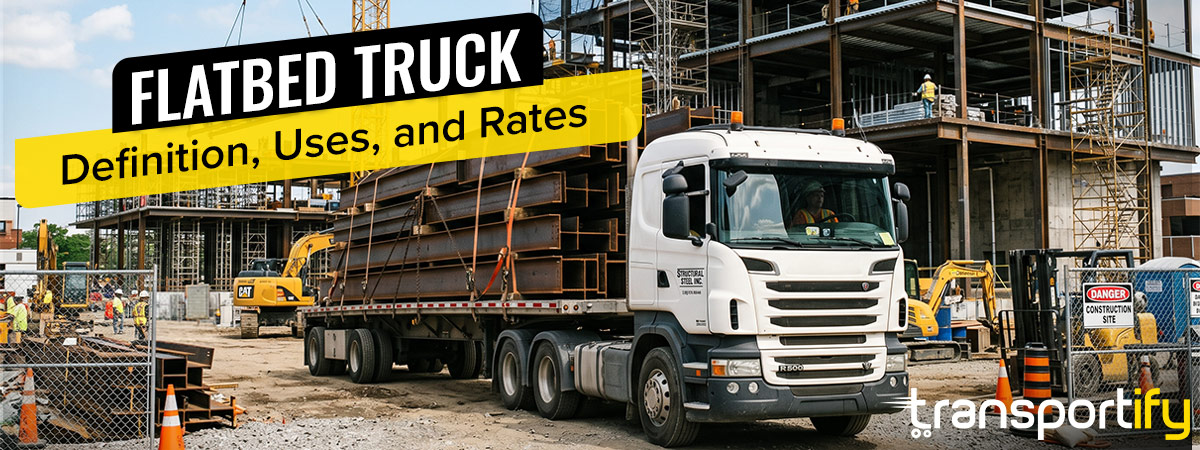
A flatbed truck is an open-deck freight vehicle built to carry oversized, heavy, or irregular cargo that standard enclosed trucks can’t accommodate. Flatbed trucks are a core asset in Philippine logistics operations. Flatbed trucks handle freight ranging from steel beams and construction materials to heavy industrial machinery across the country’s major trade corridors.
Flatbed freight transport serves industries from construction and mining to manufacturing and energy. Flatbed trucks carry distinct structural advantages, operational rules, load capacity limits, and pricing structures that differ from other commercial freight vehicles used in the Philippines.
What is a Flatbed Truck?
A flatbed truck is a freight vehicle with a flat, open cargo bed that has no side walls and no roof. A flatbed truck’s platform allows cargo to be loaded from the front, side, or rear. The loading flexibility of flatbed trucks gives it an operational advantage over box trucks and enclosed vans for large or non-stackable loads
The cargo bed itself sits on a rigid frame mounted directly behind the driver’s cab. Most standard flatbed trailers measure 48 to 53 feet in length and 8.5 feet in width, with a deck height of approximately 5 feet from ground level. Cargo transported on a flatbed deck stays exposed to outdoor conditions. Flatbed shippers use tarps, straps, and tie-down chains to protect freight in transit.
Businesses that regularly move construction supplies, industrial equipment, or project cargo rely on flatbed trucks as their primary freight vehicle. Philippine logistics providers offering truck transport services include flatbed configurations among their core fleet offerings for construction and infrastructure project clients across Luzon, Visayas, and Mindanao.
How does a Flatbed Truck Work in Logistics Operations?
A flatbed truck works in logistics operations by allowing cargo to be loaded from multiple angles using cranes, forklifts, or ramps. Flatbed operation’s multi-directional access is the defining operational characteristic that separates flatbed trucking from dock-dependent enclosed freight vehicles.
The operational workflow in freight handling follows a clear sequence. First, the flatbed truck arrives at the origin point, which could be a warehouse, a port, or a construction site. Loading equipment positions cargo onto the steel deck from the side or overhead. Each item is placed on the deck one at a time when crane operations are involved, with helpers kept in the sight line of the equipment operator throughout the lift. The freight gets secured using ratchet straps, chains, or tie-down systems before road transit. The crane or other similar equipment unloads the cargo in reverse order at the destination. Flatbed unloading at construction sites and industrial yards in Philippine logistics operations relies on the receiving site’s own forklift or mobile crane.
What Types of Cargo Can Be Transported Using a Flatbed Truck?
The types of cargo that can be transported using a flatbed truck include construction materials, heavy equipment and machinery, steel beams and metal fabrications, vehicles and oversized industrial cargo. The types of cargo transported using a flatbed truck are those that exceed the dimensional or weight limits of enclosed trailers. Flatbed cargo require side or overhead loading access and carry no sensitivity to weather exposure during transit.
- Construction materials: Cement bags, hollow blocks, lumber, precast panels, and roofing materials are common flatbed loads. Infrastructure and residential construction projects generate continuous demand for open-deck freight capacity. Construction materials are heavy, stackable to deck height, and load efficiently from the side using forklifts at supplier yards.
- Machinery and heavy equipment: Industrial machines, generators, compressors, and agricultural equipment are transported on flatbeds. Machinery and heavy equipment dimensions exceed enclosed trailer clearances and their weight requires the full structural support of an open steel deck. Crane loading is standard for machinery and heavy equipment.
- Steel beams and metal fabrications: Structural steel, I-beams, pipes, and rolled metal sections are routinely transported on flatbed trucks because their length and rigidity make them incompatible with enclosed trailers. Steel from fabricators in the Philippines is regularly moved to project sites on flatbed trucks.
- Vehicles: Cars, light trucks, and non-operational heavy equipment are transported on flatbeds when roll-on transport is unavailable or when the vehicle is immobile. Drive-on ramp loading is used for operational vehicles, while crane lifts are used for non-operational units.
- Oversized industrial cargo: Wind turbine components, modular structures, prefabricated building sections, and large diameter tanks are transported using extended or multi-axle flatbed configurations when their dimensions exceed standard trailer capacities. Oversized industrial cargo require route surveys, special permits from the Land Transportation Office (LTO), and pilot vehicle escorts in Philippine road operations.
The common requirement across flatbed cargo loads is unrestricted access to the load surface during handling that enclosed trailers cannot provide. Construction and infrastructure project cargo represents the highest-volume flatbed freight category in the Philippines.
Can a Transport Management System be used in flatbed truck logistics operations?
Yes, a Transport Management System (TMS) can be used in flatbed truck logistics operations. A Transport Management System automates scheduling, optimizes delivery routes, monitors fleet utilization, and generates shipping documentation for flatbed operations. Philippine flatbed shipments often require coordination between loading equipment providers, receiving facilities, and LTO permit processing. A TMS reduces the manual communication gaps present in flatbed operations.
Is OTR trucking used for flatbed truck long-haul transport?
Yes, OTR trucking is the standard operational model for flatbed long-haul transport across provincial and regional boundaries. Interprovincial freight transport in the Philippines is the direct equivalent of OTR trucking operations. Flatbed trucks in OTR trucking carry oversized cargo between Luzon, Visayas, and Mindanao trade corridors via road networks and Roll-on/Roll-off (RoRo) ferry connections. Long-haul flatbed routes in the Philippines serve construction, mining, and energy sector clients that move heavy equipment and structural materials between distant project sites. Route permits, load securement compliance, and driver scheduling become critical operational requirements under LTO regulations in the Philippines
Does Transportify include Flatbed Shipping in its Truck Transport Services?
Transportify does not currently offer a dedicated flatbed truck configuration in its fleet. However, Transportify’s truck transport services cover a wide range of vehicle types that serve many of the same freight requirements flatbed trucks address.
Transportify’s fleet spans economy vehicles up to large multi-axle trucks with options suited for non-standard and heavy freight. The open truck option carries cargo up to 7,000 kg with an open bed configuration that makes it suitable for lengthy construction materials like pipes and lumber. The 6-Wheel Forward (6W FWD) Truck handles payloads of up to 7,000 kg. Transportify also offers wing van trucks for high-volume shipments and closed vans in multiple size configurations for weather-sensitive cargo that does not require an open deck. Shippers whose freight requirements fall outside standard enclosed configurations can book through the platform to match the most appropriate available vehicle type to their load dimensions, weight, and destination.
Why are Flatbed Trucks Used in Freight and Logistics?
Flatbed trucks are used in freight and logistics because they transport non-standard cargo that physically can’t fit inside enclosed truck bodies. Standard enclosed trucks have fixed height, width, and length limits. Cargo that exceeds standard dimensions and loading protocols has no viable alternative to an open-deck platform.
Flatbed trucks fill the gap between standard freight vehicles and specialized heavy transport. Construction sites, ports, and manufacturing facilities operate with cranes and forklifts already on-site. A flatbed truck’s open deck integrates directly into that existing equipment workflow. Flatbed transport is an site-compatible logistics solution for industries where enclosed trucks create handling bottlenecks.
What are the Advantages of Using a Flatbed Truck?
The advantages of flatbed trucks center on access, handling speed, load flexibility, and cargo size capacity. The advantages of using a flatbed truck come directly from its open deck design that removes the physical restrictions that make enclosed trucks unsuitable for heavy, tall, or irregularly shaped cargo. The advantages of flatbed trucking make it the preferred choice for construction, industrial, and infrastructure logistics in the Philippines.
- Easy loading access: Flatbed trucks can be loaded from the sides, rear, and above which eliminates the need for dock facilities and allows cranes and forklifts to approach the cargo from any angle. Flatbed trucks are practical for loading at construction sites, open yards, and industrial facilities that have no enclosed dock infrastructure.
- No height restriction: Cargo loaded onto a flatbed deck has no overhead clearance limit imposed by the vehicle itself. Flatbed trucks are the correct choice for tall machinery, vertical structural components, and stacked materials that would exceed the internal height of an enclosed truck body.
- Faster handling: Forklifts and cranes complete flatbed loading and unloading faster than the manual cargo-moving process used in enclosed dry van operations. Flatbed drivers make fewer stops per load and spend less time waiting at pickup and delivery locations.
- Suitability for heavy and oversized freight: Flatbed trucks are built to carry payloads that regularly reach 20,000 kg or more on multi-axle configurations. The structural design of flatbed trucks makes them the standard vehicle choice for cargo weight and dimensional profiles that enclosed trailers are not rated or configured to carry.
The advantages of a flatbed truck make it an operationally critical vehicle class for freight that does not conform to the dimensional and access assumptions built into enclosed truck design. The speed and access advantages are especially relevant in the Philippine market for construction project logistics. Delivery windows at active building sites are tight and unloading equipment is typically on-site rather than at a formal dock.
What are the Disadvantages of Using a Flatbed Truck?
The disadvantages of flatbed trucks involve cargo exposure, securement complexity, and driver skill requirements. The disadvantages of using a flatbed truck arise from the same open design that creates its operational advantages.
- Weather exposure risk: Flatbed cargo has no roof or side walls, so rain, dust, humidity, and direct sunlight affect freight during transit. Shippers use tarps, shrink wrap, and waterproof covers to protect cargo, which adds preparation time and material cost to every shipment.
- Cargo securing requirements: Every item loaded onto a flatbed deck must be secured using chains, ratchet straps, winch straps, or lumber tarps before the truck moves. Improperly secured cargo shifts during transit, which affects vehicle handling and creates road safety hazards for other drivers.
- Safety dependency on proper loading practices: Flatbed loading relies on the combined judgment of the driver, forklift or crane operator, and receiving site team to execute lifts and restraints correctly. Flatbed trucks have no structural enclosure to limit the consequences of a loading error.
The disadvantages of a flatbed truck establish that flatbed transport requires more specialized handling knowledge, and rigorous compliance with load securement standards than enclosed truck alternatives. Shippers who invest in correct securing equipment and trained loading personnel reduce most of these risks before the truck leaves the origin point.
Is Less Than Truckload (LTL) shipping applicable to flatbed truck transport?
Yes, Less Than Truckload (LTL) shipping is applicable to flatbed truck transport under a specific configuration known as a partial flatbed or flatbed partial load. Less Than Truckload (LTL) for flatbed truck transport works when individual shipments are too large for enclosed trailers but do not fill a full flatbed. Flatbed LTL consolidation in the Philippines is less commonly available than enclosed LTL services. The complexity of securing mixed cargo types from different shippers on a single open deck requires carriers to apply compatible load restraint systems across all items simultaneously. Shippers with small flatbed loads in the Philippines typically opt for a dedicated open truck booking rather than consolidated flatbed LTL.
When Should a Flatbed Truck Be Used for Transport?
A flatbed truck should be used for transport when cargo exceeds the dimensional or weight limits of an enclosed truck. Flatbed trucks should also be used when side and overhead loading access is required at the origin or destination. Construction sites, industrial facilities, ports, and energy project locations are the primary environments where flatbed transport is the correct operational choice.
Construction sites use flatbed trucks as the standard choice because job sites rarely have enclosed docks and routinely receive materials like structural steel and roofing sections that are too long or heavy for enclosed vans. Active construction corridors in Metro Manila, Cavite, Batangas, and major provincial cities depend on flatbed trucks for continuous materials delivery directly to site.
Flatbed trucks for industrial delivery are selected when machinery, generators, transformers, or fabricated metal components must be transported between manufacturing plants, fabrication yards, and installation sites. Industrial loads are typically too heavy for standard closed vans and require the structural support of a reinforced open deck rated for concentrated weight distributions.
Flatbed trucks for oversized freight movement become the only compliant option when cargo dimensions exceed the interior clearances of any enclosed trailer configuration. Loads that exceed standard road clearance thresholds in the Philippines require LTO special permits and must travel on pre-surveyed routes, with pilot vehicles when required. Shippers should use a flatbed for these movements rather than attempting to modify enclosed trailer loads. Oversized cargo in enclosed trailers creates internal structural stress and handling risks that flatbeds are engineered to avoid.
What are the Differences Between Flatbed Trucks and Enclosed Trucks?
The key differences between flatbed and enclosed trucks cover cargo protection, loading flexibility, weather resistance, and operational use cases. Flatbed trucks and enclosed trucks serve different freight requirements The selection between a flatbed truck or an enclosed truck depends on cargo type, protection needs, and loading conditions made.
| Factor | Flatbed Trucks | Enclosed Trucks |
|---|---|---|
| Cargo protection level | Low. Cargo is fully exposed to outdoor elements during transit. | High. Cargo sits inside a sealed body. |
| Loading flexibility | Cargo loads from the front, sides, or above using cranes, forklifts, or ramps. | Limited. Cargo enters and exits through the rear door only. |
| Weather resistance | None from the truck itself. Shippers apply tarps, shrink wrap, and waterproof covers. | Full. The enclosed body protects cargo from the weather. |
| Operational use cases | Construction, mining, infrastructure, heavy equipment transport, and oversized industrial freight. | General retail freight, packaged goods, food and beverage, electronics, and temperature-sensitive cargo. |
The choice between flatbed and enclosed transport comes down to whether the cargo needs protection or access. Cargo that’s built to handle outdoor exposure gets faster, more flexible handling on a flatbed deck. Cargo that’s fragile, high-value, or weather-sensitive belongs in an enclosed body.
How is Cargo Secured on a Flatbed Truck?
Cargo is secured on a flatbed truck using a combination of tie-down straps, chains, binders, tarps, and load-balancing techniques that prevent shifting during transit. The securement method used depends on the cargo’s weight, shape, and surface material. Every flatbed shipment in the Philippines must meet LTO load securement standards before the truck departs the loading area.
Ratchet straps and tie-down straps are the most commonly used securement tools for flatbed freight. Straps attach to the deck’s anchor points and tighten over the cargo using a ratchet mechanism. Direct tie-downs anchor the cargo to the deck, while indirect tie-downs loop over the top of the load.
Chains and binders are used for heavy cargo like steel beams, machinery, and industrial equipment. Chains connect to the deck’s anchor points and are tightened using ratchet or lever binders to apply tension that keeps the cargo from shifting at highway speeds.
Tarps and edge protectors cover cargo to protect it from weather exposure and prevent strap abrasion at contact points. Edge protectors are placed between the strap and the cargo’s sharp corners to prevent cutting during transit.
Load balancing and weight distribution require that cargo weight is spread evenly across the flatbed deck. Uneven weight distribution affects vehicle handling, braking distance, and tire load on Philippine road conditions.
Is there a difference between Local Trucking and Regional Trucking in flatbed operations?
Yes, local trucking and regional trucking differ in flatbed operations primarily in terms of route distance, permit requirements, and driver scheduling. Local flatbed trucking covers short-distance deliveries within a city or metro area. Local trucking typically completes multiple trips in a single day. Regional flatbed trucking covers inter-provincial routes that span longer distances and require LTO special permits for oversized cargo. Regional trucking often involves overnight transits or RoRo ferry connections between island groups. The securement standards and load documentation requirements are stricter for regional flatbed operations because the cargo spends more time on the road and crosses multiple jurisdictions.
What is the Load Capacity of a Flatbed Truck?
The load capacity of a flatbed truck in the Philippines ranges from 3,000 kg for a standard 4-wheel flatbed to 42,000 kg gross vehicle weight for the largest multi-axle flatbed trailer configurations. Axle configuration directly determines how much weight a flatbed truck can legally carry on Philippine roads. A 2-axle truck with 6 wheels carries a maximum GVW of 18,000 kg. A 3-axle truck with 10 wheels carries up to 33,300 kg. A truck-trailer configuration with 2 axles at the motor vehicle and 2 axles at the trailer reaches 40,600 kg, while a full 3-axle motor vehicle with a 3-axle trailer reaches the maximum allowable GVW of 42,000 kg.
Flatbed truck size also affects usable deck capacity. Smaller flatbed trucks used for local deliveries carry between 2,000 kg and 7,000 kg. Full semi-trailer flatbeds used for inter-provincial or regional freight handle 12,000 kg to 28,000 kg of cargo. Loads that exceed DPWH GVW limits require a special hauling permit before the truck departs, and carriers that exceed axle load thresholds on public roads face penalties under Philippine trucking regulations.
How is Cargo Secured on a Flatbed Truck?
The primary industries that rely on flatbed truck transport in the Philippines involve construction, manufacturing, agriculture, infrastructure, and heavy equipment logistics. The industries that use flatbed trucks for transport are those whose core supply chains regularly move cargo that is too large for enclosed trucks to carry on standard routes.
- Construction: The construction industry generates the highest volume of flatbed freight demand in the Philippines. The construction industry moves structural steel, precast concrete components, hollow blocks, roofing materials, and scaffolding from suppliers and fabricators to active project sites. Flatbed deliveries are scheduled around site pour schedules, steel erection timelines, and material staging sequences.
- Manufacturing: Manufacturing plants use flatbed trucks to receive raw material inputs like steel coils, metal sheets, large resin drums, and machine components. Philippine manufacturing hubs in Laguna, Cavite, and Batangas rely on flatbed movements as a core part of their inbound and outbound logistics operations.
- Agriculture: The agriculture sector uses flatbed trucks to move bulk harvests in sacks and pallets, farm machinery and irrigation equipment.
- Infrastructure development: Government infrastructure projects use flatbed trucks to transport bridge girders, culverts, drainage sections, and road construction equipment to project sites along national and local road corridors. The government sector drives consistent flatbed demand independent of private construction cycles.
- Heavy equipment logistics: The heavy equipment rental and relocation sector depends entirely on flatbed trucks to move excavators, bulldozers, motor graders, and pile drivers between project sites. Heavy equipment loads require low-bed or extendable flatbed trailers.
Flatbed transport is embedded in the Philippine economy. The industries that use flatbed trucks are the same industries responsible for building infrastructure, producing goods, and developing energy resources across the archipelago.
How Much does Flatbed Truck Transport Cost in the Philippines?
Flatbed truck transport in the Philippines does not have a single standard rate. Costs vary by vehicle size, total distance, cargo weight, route complexity, and whether special permits or additional manpower are required.. Flatbed rentals in the Philippines start at PHP 3,500 to PHP 6,000 per trip for short local hauls within Metro Manila or nearby provinces. Interprovincial flatbed transport covering Luzon routes ranges from PHP 8,000 to PHP 25,000 above.
Distance is the primary cost driver. Short Metro Manila flatbed deliveries covering 20 to 50 km are priced substantially lower than provincial hauls from Metro Manila to Visayas or Mindanao. Fuel cost moves in direct proportion to distance and diesel price levels, which in the Philippines fluctuate with international oil prices and are a persistent variable in trucking cost calculations.
Cargo weight affects cost through axle load compliance requirements. Heavier loads require larger, multi-axle configurations that command higher base rates and may trigger DPWH load-limit surcharges if cargo is not properly distributed. Urgency adds cost when shippers require same-day booking or priority scheduling that displaces other loads from a carrier’s queue.
Route complexity is a cost multiplier that is specific to flatbed operations. Routes passing through Metro Manila truck ban zones, low-clearance bridges, or narrow provincial roads require pre-trip route surveys, alternate scheduling, or permit coordination that add administrative cost on top of the base hauling rate.
What Factors Affect Flatbed Truck Pricing?
The factors that affect flatbed truck pricing are cargo size, permits, insurance, manpower, fuel cost, and logistics complexity. Flatbed truck pricing is affected by a set of cost variables that interact with each other, and understanding each one helps shippers anticipate total delivery cost before confirming a booking.
- Cargo size and weight: Larger and heavier loads require bigger truck configurations with higher base rates. Oversized cargo that exceeds standard road clearance limits triggers special permit processing fees and may require escort vehicles. Each incremental increase in cargo dimensions or weight above the standard flatbed rating adds a measurable premium to the final price.
- Special permits: LTO and DPWH special permits are required for cargo that exceeds standard road weight and dimensional limits. Permit fees vary by cargo class and route, and some oversized movements require local government unit clearances along the route in addition to national permits.
- Insurance: Cargo insurance and third-party liability coverage for flatbed loads are priced according to cargo value, route risk, and transit duration, with open-deck exposure. Shippers carrying high-value machinery or fabricated components on flatbeds typically pay a higher insurance premium than equivalent loads on enclosed vehicles.
- Manpower for loading and unloading: Crane operators, riggers, and lashing crews at loading and unloading points are billed per job. Large or complex cargo requiring multiple personnel at origin and destination increases total handling costs beyond the base transport rate.
- Fuel cost: Flatbed trucks carrying heavy loads consume more fuel per kilometer than standard delivery vehicles. Diesel price fluctuations in the Philippines directly affect per-kilometer freight rates, particularly for inter-provincial routes exceeding 200 km.
- Logistics complexity: Routes with truck bans, ferry crossings, multiple delivery stops, loading holds, or restricted access sites carry a complexity premium. Route and logistics complexities require more driver time, more coordination, and greater scheduling risk than straightforward point-to-point deliveries.
Flatbed pricing in the Philippines rewards shippers who plan shipments in advance. Carriers offer better rates for confirmed bookings with complete cargo specifications because it allows them to pre-arrange permits, equipment, and driver scheduling before the trip.
Can Trucking Quotes be obtained online in the Philippines using Transportify?
Yes, trucking quotes are available online through Transportify’s platform. Transportify’s platform allows shippers to get instant rate estimates based on vehicle type, pickup location, destination, and cargo details without calling a dispatcher. The Transportify price calculator covers multiple vehicle configurations and displays base rates and per-kilometer charges for Metro Manila, provincial Luzon, Visayas, and Mindanao service areas. Shippers with recurring freight needs can use the platform to book and manage multiple truck trips, compare vehicle options, and track deliveries in real time after confirming a quote.
Is Insurance Required for Flatbed Truck Cargo Transport?
No, cargo insurance for flatbed truck transport is not legally mandated in the Philippines, but it is strongly recommended. Flatbed cargo carries a higher risk exposure than enclosed truck freight because the open deck leaves cargo fully exposed to weather, road vibration, theft, and shifting during transit. Philippine law requires Compulsory Third Party Liability (CTPL) insurance on the truck itself, but CTPL only covers road accident liability for third parties and does not protect the value of cargo on the flatbed deck.
What Safety Rules Must Be Followed in Flatbed Truck Operations?
The safety rules that must be followed in flatbed truck operations cover load securing compliance, road safety rules, cargo restraint standards, and operational protocols that govern driver behavior. Flatbed operations carry a higher inherent safety risk than enclosed truck transport because cargo is exposed and entirely dependent on manual restraint systems.
- Load securing compliance: All cargo on a flatbed deck must be secured using tie-downs with a working load limit that meets at least 20% of the cargo weight to prevent vertical movement during transit. Each tie-down device has a working load limit that exceeds half the weight of the cargo it secures.
- Road safety rules: Flatbed drivers in the Philippines must comply with LTO truck ban schedules in Metro Manila and other urban centers, adhere to speed limits on national and provincial highways, and carry all required vehicle registration, driver’s license, and cargo permit documents during transit. Routes crossing bridges rated below the truck’s GVW must be identified during pre-trip planning and avoided or cleared with DPWH before travel.
- Cargo restraint standards: Tie-down devices must be inspected before each use for wear, corrosion, or mechanical damage that reduces holding strength. Chains, straps, and binders must be re-tensioned at the first stop after departure and at every scheduled rest stop thereafter, as road vibration loosens restraints progressively during long-haul operations.
- Operational protocols: Drivers must not allow any person other than the driver to be present on the flatbed deck during loading or transit. Flatbed drivers must use appropriate personal protective equipment during loading and unloading operations and follow a pre-departure checklist that includes cargo placement, tie-down verification, tarp securing, and axle load distribution confirmation.
Safety compliance in flatbed operations directly affects whether a delivery succeeds or ends in a road incident, damaged load, or suspended carrier permit. Operators who build mandatory weighing and mid-trip inspection stops into their standard operating procedures consistently reduce both cargo damage incidents and DPWH roadside enforcement violations
How are Oversized Loads Transported Using Flatbed Trucks?
Oversized loads are transported using flatbed trucks through a regulated process that requires advance permitting, route planning, escort vehicle deployment, and compliance with DPWH restrictions. Any cargo that exceeds the standard Maximum Allowable Gross Vehicle Weight (MAGVW) Matrix under Republic Act No. 8794 requires a Highway Travel Permit (HTP) from the DPWH before it can move on national highways.
The permit process starts with the carrier submitting cargo dimensions, weight, axle configuration, and the planned route to the DPWH for evaluation. The DPWH reviews whether the route’s bridges, underpasses, and road surfaces can accommodate the load without structural risk. Routes that pass through structurally sensitive roads may require detours or additional engineering clearances.
Escort vehicle requirements apply to all oversize flatbed movements on Philippine roads. A rear escort vehicle must follow the oversize truck at all times. Front escort vehicles are required for wider or longer loads. Oversized flatbed trucks are restricted to a maximum road speed of 60 to 80 kph and a maximum cargo overhang of 1.0 meter beyond the deck.
Carriers that violate HTP conditions face apprehension, suspension of operating privileges, and denial of future highway entry by DPWH and expressway operators. Shippers planning oversized flatbed movements in the Philippines engage specialized hauling contractors who manage the full permit process, escort coordination, and route clearance as part of their service.
How are Oversized Loads Transported Using Flatbed Trucks?
The right truck for a cargo shipment is chosen by matching the cargo’s weight, physical dimensions, handling requirements, delivery urgency, and route conditions to the correct vehicle configuration. A mismatch between cargo and truck type results in overloading violations, damaged freight, or failed delivery attempts at job sites where the wrong vehicle can’t be unloaded.
Cargo type determines the enclosure requirement. Packaged goods, electronics, food, and weather-sensitive materials require enclosed closed vans that protect cargo from rain and dust throughout transit. Construction materials, machinery, steel, and oversized components require open-deck trucks or flatbeds that allow crane and forklift access from any angle. Choosing an enclosed van for a flatbed cargo profile simply means the load cannot be physically placed inside the vehicle.
Total weight determines the axle configuration. A shipper must know the total cargo weight before selecting a vehicle, and that weight must fall within the selected vehicle’s rated payload. Light trucks below 2,000 kg suit last-mile and city deliveries. Medium trucks between 2,000 kg and 5,000 kg serve regional logistics and construction material movements. Heavy trucks above 5,000 kg handle long-haul industrial freight, bulk materials, and machinery.
Cargo dimensions determine whether a standard vehicle fits or whether a special configuration is needed. Cargo that is taller than the interior clearance of an enclosed van, longer than a standard flatbed deck, or wider than road regulations allow without a permit requires either a different vehicle class or a permit process before booking.
Urgency determines whether the trip is scheduled around fixed carrier windows or requires on-demand booking. Time-critical deliveries to construction sites with tight pour schedules or project milestones require carriers that can confirm same-day or next-day availability rather than fitting the load into a pre-planned route cycle.
Handling requirements at pickup and delivery determine whether a standard vehicle and driver are sufficient or whether additional equipment and personnel must be arranged. Sites without forklifts or cranes require carriers who include loading assistance in their service, while sites with crane access on both ends allow the shipper to use any vehicle configuration that fits the load dimensions and weight.
What are Common Mistakes When Using Flatbed Trucks?
The most common mistakes in flatbed truck use involve overloading, poor cargo securing, wrong truck selection, and missing permits. Flatbed truck operations fail most often because of errors made before the truck leaves the origin point. Each of the common mistakes made while using flatbed trucks carries financial, legal, and safety consequences that are preventable with proper pre-trip planning.
- Overloading: Placing cargo that exceeds the truck’s legal axle load limit is a common flatbed violation in the Philippines. Flatbed trucks caught overloading face fines, forced offloading, and potential suspension of the carrier’s operating certificate
- Poor cargo securing: Using worn, incorrectly rated, or insufficient tie-downs allows cargo to shift or fall from the deck during transit. A single improperly secured steel beam or machinery unit on a Philippine highway creates a road hazard that affects every other vehicle behind the flatbed truck.
- Wrong truck selection: Booking a flatbed truck for cargo that requires an enclosed body, or choosing a truck that’s too small for the load’s dimensions, leads to rejected shipments at the origin or cargo damage from weather exposure during transit.
- Missing permits: Moving oversized cargo on national highways without proper permits is a direct regulatory violation. Carriers caught without permits in the Philippines face apprehension at DPWH checkpoints and expressway entry points, and the shipment is stopped until compliance is achieved.
Operators who standardize a pre-booking checklist that covers cargo weight, dimensions, restraint requirements, and permit eligibility before every flatbed job consistently avoid the enforcement, damage, and operational failure costs that these mistakes generate







 Chat
Chat