



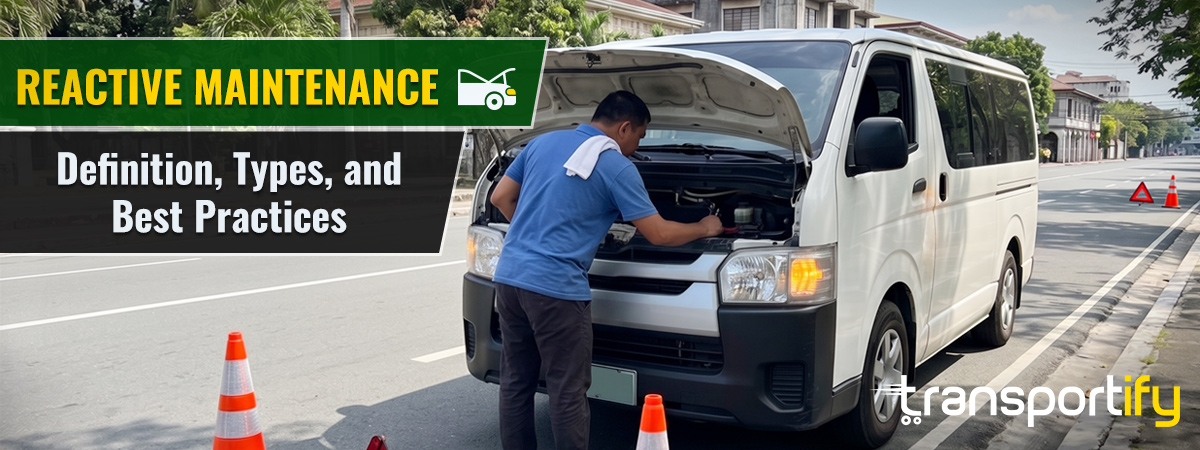
Reactive maintenance is a repair strategy within maintenance management where equipment runs until it fails before any fix is applied. Reactive maintenance mainly differs from preventive maintenance in timing. Preventive maintenance follows a schedule while reactive work only starts after a breakdown occurs. Unplanned equipment failures disrupt fleet operations by triggering route delays and emergency repair costs that a scheduled program would have avoided. A functioning emergency repair protocol, built around incident logging, dispatch, and triage, is what keeps a run-to-failure strategy from turning into total operational disruption when something breaks.
What is Reactive Maintenance?
Reactive maintenance is a maintenance strategy where equipment is allowed to run until it fails, and repairs are performed only after that failure occurs. Reactive maintenance is based on the run-to-failure concept. Run-to-failure means an asset keeps operating until it breaks down and forces a repair. Trucks, or machines under the run-to-failure model get no preventive attention. No scheduled inspections for reactive maintenance means that technicians don’t check the asset at set intervals. Technicians wait for a failure signal instead. Higher unpredictability is a risk for this approach, since costs and downtime swing widely because nobody knows when the next failure hits.
Reactive maintenance usually involves emergency labor, expedited parts, and lost production time because the trigger is an unexpected breakdown. The reactive approach to maintenance can be acceptable for low-cost, non-critical assets where the cost of monitoring would be higher than repairing or replacing the item after it fails. This maintenance approach, however, carries significant risk when applied to core fleet vehicles, or sorting equipment that a logistics operation depends on every day.
How Does Reactive Maintenance Differ from Preventive Maintenance in Fleet Operations?
Reactive maintenance differs from preventive maintenance primarily in the timing of maintenance activities. Reactive maintenance’s timing is dependent on failure and preventive maintenance is based on schedule. The timing difference leads to different cost and reliability outcomes.
-
- Timing Trigger: Reactive maintenance starts after a breakdown occurs, while preventive maintenance follows a fixed calendar or interval set in advance.
- Cost Structure: Reactive repairs involve emergency labor rates and rushed part sourcing, while preventive maintenance spreads cost across planned service visits with set parts pricing.
- Vehicle Availability: Reactive maintenance pulls a vehicle out of service unexpectedly, potentially disrupting the day’s route plan, while preventive maintenance is scheduled during planned downtime that doesn’t interfere with active deliveries.
- Safety Exposure: Reactive maintenance carries higher safety risk because a failure can occur mid-route, whereas preventive maintenance catches wear before it becomes a road hazard.
- Driver Impact: Frequent reactive breakdowns erode driver confidence in vehicle reliability, while a well-maintained fleet under a preventive program supports driver retention.
A fleet that shifts its most breakdown-prone vehicles onto a preventive schedule sees fewer emergency repair events within the first service cycle.
Why do Unplanned Equipment Breakdowns Disrupt Fleet Operations?
Unplanned equipment breakdowns in fleet operations refer to sudden equipment failures that pull an asset out of service without warning that disrupt deliveries and sorting operations. The effects of sudden equipment breakdowns propagate outward from the asset through the rest of the operation.
-
- Cascading Delays: Breakdowns force dispatch to reroute assigned deliveries to other vehicles, which pushes back those vehicles’ original schedules and delays subsequent stops on their routes.
- Emergency Overhead Costs: Rush repairs incur costs from labor rates and parts procurement which cost more than a scheduled repair.
- Customer Service Quality: Missed delivery windows caused by breakdown-related delays put the business at risk of violating service level agreements and reduced trust with clients.
- Driver Overtime: Rerouted drivers absorbing extra stops from a broken-down vehicle often work beyond their scheduled hours that adds labor cost on top of the repair itself.
The disruption from a single point of failure spreads through the entire delivery network long after the broken vehicle has already been pulled off the road.
Does Run-to-Failure Storage Strategy Increase Overall Operational Expenses?
Yes, run-to-failure storage strategies raise overall operational expenses because emergency repairs and idle assets cost more than scheduled servicing. Every unplanned breakdown pulls a vehicle off the road and translates directly into missed deliveries and idle drivers. Fleet operators running multiple trucks across Philippine cities that operate on a run-to-failure model are susceptible to elevated repair costs.
What are the Main Elements of an Emergency Repair Protocol?
The main elements of an emergency repair protocol are encapsulated in a standard crisis response blueprint. A standard crisis response blueprint for equipment failure is a defined sequence of steps that a maintenance team follows the moment a breakdown is reported. The crisis response is designed to work the same way at any point in time. The baseline elements of this blueprint are consistent across fleet and facility maintenance operations.
- Incident Logging: The first responder records the failure details, including timestamp, asset ID, and observed failures. The incident logging step creates a documented record before any repair work begins.
- Triage: The severity of the failure is classified into emergency, critical, or standard categories. The triage step determines how fast a response team must be dispatched.
- Dispatch: The appropriate repair crew or roadside service unit is assigned and sent to the failure location, with response time targets tied to the severity level.
- Escalation Path: A defined chain of contacts ensures that if a technician doesn’t respond within a set window, the issue automatically escalates to a supervisor or backup vendor.
- Documentation and Root Cause Review: The team records what failed and why after repair. Data from the documentation and review feed into future maintenance planning to reduce repeat incidents.
A protocol built on the main elements of an emergency repair turns breakdowns into a manageable, repeatable process. Fleet operators that formalize this blueprint typically see the gap between failure detection and repair completion decrease over time as the escalation and dispatch steps become routine.
How Does Sudden Machinery Malfunction Impact Daily Sorting Workflows?
Sudden machinery malfunction impacts daily sorting workflows by causing operational delays which cascades to succeeding processes. As an example, a sudden conveyor belt failure at a sorting hub forces the entire facility into manual parcel handling within minutes of the breakdown. The shift supervisor halts inbound parcel flow to the affected section and directs staff to manually pull parcels off the stalled line before they cause a bottleneck. Workers then sort the backlogged parcels by hand by manually routing each item to the correct staging area that the belt would normally have handled automatically.
This manual sorting slows output significantly due to efficiency loss from the breaking of the automated sorting systems. The facility must temporarily reassign staff from other tasks to cover the sorting gap. Supervisors typically activate a backup conveyor segment or a secondary sorting line if one is available. Once the repair crew clears the failure, the facility gradually reintroduces automated flow while continuing manual backup handling for any parcels still in the queue until the sort rate returns to normal.
Can Unscheduled Asset Downtime Compromise Last-Mile Logistics Networks?
Yes, unscheduled asset downtime can compromise last-mile logistics networks because a failed vehicle or sorting asset removes capacity when delivery windows are tightest. Last-mile delivery runs on time-boxed routes, and pulling one truck out mid-shift forces dispatchers to delay deliveries or overload other drivers to cover the gap. Repeated downtime also reduces customer trust and how much of the fleet’s total capacity gets used. An unplanned breakdown in dense urban routes such as Metro Manila are more prone to causing missed or delayed delivery windows due to other risk factors such as traffic.
What are the Different Scenarios for Deploying Reactive Maintenance?
Fleet teams deploy reactive maintenance across distinct scenarios that are each triggered by a different type of failure or business decision. Some scenarios come from a deliberate strategy choice, while others get forced onto the team by a sudden event outside their control.
- Inherent Run-to-Failure Asset Strategies: Teams intentionally skip scheduled upkeep on low-value and easily replaceable parts because servicing them costs more than letting them fail.
- Emergency Breakdown Unplanned Malfunctions: Critical machinery stops without warning that forces an immediate repair response.
- Deferred Maintenance Secondary Failures: Postponed minor repairs pile up into a backlog that eventually triggers a chain of related component failures.
- Weather-Induced Transit Fleet Casualties: Sudden weather events like floods or fallen debris disable a delivery vehicle mid-route, requiring roadside rescue.
- Regulatory Defect Roadside Groundings: A vehicle fails a compliance inspection and gets pulled from service on the spot.
Each scenario calls for a different response speed and repair approach, even though all five fall under the reactive maintenance umbrella.
1. Inherent Run-to-Failure Asset Strategies
Inherent run-to-failure asset strategies are a deliberate maintenance decision where non-critical parts are left to operate until they break, rather than being monitored on a preventive schedule. Non-critical asset management functions through an asset criticality analysis, which scores each component based on the consequence of its failure across factors like safety, and repair cost. Components are classified as acceptable candidates for run-to-failure treatment if they have the lowest combined criticality score.
Non-essential parts are left to fail before replacement because the cost of continuously inspecting them ahead of schedule would exceed the cost of reacting once they break. Fleet operators apply this approach to conserve labor and budget for components where the controlled risk is acceptable.
2. Emergency Breakdown Unplanned Malfunctions
Emergency breakdown unplanned malfunctions occur when critical machinery stops functioning without warning. Unplanned malfunctions cut off an operation’s core capability the moment the failure happens. Catastrophic failure refers to a sudden and complete loss of function in a component that the operation depends on to continue running.
Maintenance teams react by isolating the failed asset to prevent further damage when critical machinery fails. Maintenance teams then dispatch a technician or roadside unit immediately. The response prioritizes speed over cost efficiency, since every hour the asset remains down adds to lost productivity or missed delivery windows.
3. Deferred Maintenance Secondary Failures
Deferred maintenance secondary failures occur when a minor repair is postponed which eventually causes a chain reaction of additional component failures. Backlog risk refers to the accumulated exposure created by unresolved maintenance tasks sitting in a queue. Each additional day of delay increases the likelihood that the original issue triggers damage to a connected system.
Delaying minor repairs causes a domino effect because small mechanical issues rarely stay isolated. As an example, a small fluid leak ignored for weeks can lead to a complete component failure. Deferred maintenance backlogs are risky for fleet operators because a single deficiency can escalate into a full vehicle breakdown.
4. Weather-Induced Transit Fleet Casualties
Weather-induced transit fleet casualties occur when sudden climate events damage a delivery vehicle mid-route. Vehicles damaged by weather events require roadside recovery to restore the vehicle or protect its cargo. Acute climate failure refers to a rapid, weather-triggered mechanical or electrical fault from prolonged wet-road exposure.
Roadside support rescues delivery trucks struck by sudden road hazards through a structured response chain. The driver first reports the incident and location to dispatch. A roadside assistance provider is then contacted to send a recovery unit to repair or tow the vehicle. Flooding and typhoons are recurring seasonal risks in the Philippines hence fleet operators are recommended to build a weather-triggered breakdown response into their standard operating procedures.
5. Regulatory Defect Roadside Groundings
Regulatory defect roadside groundings occur when a vehicle fails a mandatory roadworthiness inspection that forces an immediate and unscheduled repair before the vehicle can legally return to operation. Compliance enforcement refers to the legal authority a regulator holds to physically stop a vehicle from operating once an inspector identifies a defect that fails to meet safety standards.
Land Transportation Office (LTO) officers in the Philippines can apprehend a vehicle on the road if it shows visibly defective parts. Once apprehended, the vehicle must undergo a formal roadworthiness inspection at an LTO-certified Motor Vehicle Inspection Center (MVIC) before it is cleared to return to the road.
How Do Fleet Dispatch Systems Handle Unplanned Repair Workflows?
Fleet dispatch systems handle unplanned repair workflows through a connected sequence that starts the moment a vehicle breaks down and ends when a technician arrives to fix it. The process starts the moment a driver’s onboard diagnostics or a manual call flags a roadside breakdown. An automatic alert is sent to the dispatch team’s software. The dispatcher logs the incident into the system to capture the vehicle’s location and the reported fault. The computerized maintenance management system (CMMS) module assigns a priority tier to the job based on factors like safety risk and vehicle importance to daily operations. The CMMS then searches for the nearest available technician and sends the job directly to that person. GPS-based tracking lets the dispatcher watch the technician’s live location and estimated arrival time.
What Functional Capabilities Must a Crisis CMMS Module Possess?
A crisis CMMS module must function as an emergency work order platform that is capable of detecting a breakdown, generating work orders, and connecting the proper technician to the right asset without manual coordination.
- Automatic Emergency Work Order Creation: The system creates a work order the instant a breakdown is reported or detected. The system tags it as critical so it bypasses the standard queue automatically.
- Real-Time Technician Mapping: The platform tracks technician location and availability continuously to allow dispatch to assign the closest qualified responder rather than the next technician in a static rotation.
- Express Parts Expediting: The system checks the parts inventory to flag parts shortages so a replacement can be sourced as needed.
- Skill-Based Auto-Routing: The module matches each emergency case to a technician whose certifications and trade specialty fit the specific failure type.
- Live Status Visibility: Fleet managers and affected drivers receive real-time updates on work order progress without needing to call for a manual status check.
The functional capabilities of a crisis CMMS work together to compress the time between breakdown detection and repair completion.
How Does a Telematics System Alert Dispatchers to Sudden Vehicle Failures?
A telematics system alerts dispatchers to sudden vehicle failures by continuously monitoring the truck’s onboard diagnostics computer and transmitting any detected fault code to the operations office. The vehicle’s control system generates a diagnostic trouble code (DTC) whenever a monitored parameter, such as engine temperature, or brake pressure, operates outside its programmed safe range. The telematics unit reads the DTC directly from the vehicle’s data bus, and pushes it wirelessly to the fleet management platform in real time.
The system cross-references the code against a severity library to determine whether the issue is minor or critical. Fleets using real-time DTC monitoring have reduced breakdowns and cut unplanned downtime, since faults get caught and addressed before they escalate into a full roadside failure. For the faults that escalate to full breakdowns, the dispatcher already has the exact fault details to take immediate action.
How Can a Garage Management System Fast-Track Emergency Work Orders?
A garage management system fast-tracks emergency work orders by overriding the standard queue and triggering emergency response from the technicians. The process begins the moment a last-mile delivery van breakdown is reported to the system, which triggers the first step in the override sequence.
-
- Emergency Tag Applied: The dispatcher or the system flags the incoming work order with an “Emergency” classification to automatically bypass the standard scored queue.
- Automatic Priority Recalculation: The system re-scores every pending job in the queue against the new emergency case and moves the vehicle repair to the top position of the queue.
- Technician Reallocation: The platform checks which technician is currently best positioned to take the case, based on skill certification and proximity. The system reassigns the technician away from a lower-priority task if needed.
- Parts Reservation Override: Inventory tied to the emergency work order gets reserved ahead of parts allocated to non-urgent jobs to ensure the repair isn’t delayed by a stock conflict.
- Real-Time Confirmation: The system sends an immediate notification to the fleet manager and the technician confirming the queue override. All parties are informed that the standard workflow has been intentionally bypassed for this case.
This override sequence only works because the underlying management platform treats work order type as a workflow trigger. A shop still running paper-based prioritization cannot replicate the speed of the automated system, since manually re-sorting a physical job queue takes longer than a system-driven recalculation.
Can Automated Roadside Dispatch Applications Reduce Truck Fleet Downtime?
Yes, automated roadside dispatch applications reduce truck fleet downtime by cutting the manual coordination time between a breakdown report and a technician’s arrival. Roadside dispatch applications can match a stranded vehicle to the nearest available service unit automatically by replacing the slower manual process of calling for help. Live tracking then lets the office monitor technician progress in real time that shortens the uncertainty window. For Philippine fleets navigating congested routes across Metro Manila and other urban centers, expediting a dispatch response can prevent a single breakdown from cascading into missed delivery windows for the rest of the day.
How is Reactive Maintenance Executed on Stranded Delivery Trucks?
Reactive maintenance is executed on stranded delivery trucks through roadside vehicle recovery. Roadside vehicle recovery is the process of repairing, or towing a broken-down commercial vehicle at the location where it fails. Roadside vehicle recovery starts with the driver pulling the truck as far off the traffic lane as possible and engaging hazard lights. The driver can also place warning cones at set distances to alert oncoming vehicles if possible. The warning zone for heavy trucks extends further than passenger cars, since stopping distances and driver sightlines both increase with vehicle size. Once the scene is secured, the driver contacts dispatch to report the fault and location. A technician or tow unit gets sent out based on the severity of the issue. If the cargo is time-sensitive, dispatch can activate any contingency plan tied to that specific cargo type before the recovery team even arrives on-site.
What Core Mechanical Protocols Guide Roadside Fleet Recovery?
Roadside fleet recovery follows several core mechanical protocols designed to recover a stranded truck, and get the vehicle back into service. Field diagnostics is the on-site assessment technicians perform to identify a fault’s root cause before deciding whether to repair the vehicle roadside or tow it to a shop.
- Towing Logistics: Coordinating the tow vehicle, load capacity, and destination shop before dispatch. This is done to ensure the recovery truck arrives with the right equipment for the specific breakdown.
- Mobile Service Safety Zones: Establishing a protected work perimeter around the stalled truck using hazard markers positioned at distances scaled to the vehicle’s size and the road’s traffic speed.
- Hot-Swapping Parts: Replacing a failed component with a pre-stocked spare carried on the mobile service unit itself.
These protocols work in sequence to ensure the quickness and safety of roadside recovery. Field diagnostics determine whether hot-swapping is even possible, and towing logistics only get activated once diagnostics rule out an on-site fix within a safe timeframe.
Does Rapid Deployment of Mobile Service Units Protect Perishable Delivery Cargo?
Yes, rapid deployment of mobile service units protects perishable delivery cargo by minimizing the window during which refrigerated goods sit without active temperature control. Inadequate air distribution inside a stalled cargo compartment is a leading cause of spoilage, even when the refrigeration unit itself is working properly. A delayed response compounds that risk. A broken-down reefer truck loses its cooling capacity when its engine or auxiliary power shuts off. Rapid deployment ensures that power is restored to the refrigeration unit or cargo is transferred to another cooled vehicle. Rapid deployment of service units is especially important for Philippine fleets as the country’s tropical climate may accelerate the spoilage process.
How Should Damaged Last-Mile Vans and Sorting Belts Be Triaged?
Triaging a damaged last-mile van or sorting belt starts with a visual inspection to spot obvious damage. The technician then checks how much of the asset’s function is affected. For a conveyor belt, that means measuring how much of the belt’s width shows damage. For a van, the technician isolates the fault to a single system, whether that’s the engine, brakes, or electrical wiring. A fault confined to one system almost always repairs faster than one that has spread to connected parts. Once the technician confirms the scope of damage, they estimate a fix time based on parts availability and whether the repair can happen on-site or needs a full shop visit. The technician’s estimate then drives the decision to either patch the asset immediately or pull it from service until parts arrive.
Are Strict Safety Procedures Mandated During Emergency Roadside Truck Overhauls?
Yes, strict safety procedures are mandated during emergency roadside truck overhauls because a stopped vehicle on an active road creates immediate danger for the crew and passing traffic. Standard protocol requires the driver to move the truck off the traffic lane and set hazard lights. Technicians working on the vehicle wear high-visibility gear and avoid standing between the truck and oncoming traffic while performing any roadside repair. Failing to follow mandated procedures during a roadside recovery process significantly raises the risk of a technician or driver being struck by passing traffic.
How do Unplanned Repairs Disrupt Broader Supply Chain Commitments?
Unplanned repairs disrupt broader supply chain commitments as a single equipment failure propagates outward through the fulfillment chain. Unplanned repairs cause delays at every downstream process that depended on that asset’s output. When a sorting conveyor stalls at a distribution hub, parcels queued behind it back up and push outbound trucks to depart later than their schedule.
Dispatch delays from unplanned repairs forces drivers to rush the remaining route or push deliveries beyond the promised fulfillment time. The disruption compounds further when the delayed shipment was itself feeding a downstream process, such as a retailer’s next-day restock or a manufacturer’s just-in-time input, since that recipient now inherits the delay and must adjust their own commitments in turn.
How Does Roadside Asset Breakdown Jeopardize Commercial Delivery SLA Compliance?
Roadside asset breakdown jeopardizes commercial delivery SLA compliance by disrupting delivery timelines and fulfillment. A single truck failure reduces the time to fulfill the scheduled delivery window.
- Route Interruption: The truck stops moving, and every stop remaining on its route immediately falls behind schedule, with no automatic mechanism to recover the lost time unless another vehicle is rerouted to cover it.
- SLA Clock Continues: Most commercial delivery contracts do not pause the delivery deadline just because a mechanical failure occurred. The SLA clock keeps running against the shipper regardless of the cause of delay.
- Penalty Threshold Triggered: The contract’s penalty clause activates once the delivery misses its committed window.
- Vendor Relationship Strain: A missed SLA damages the working relationship with the client. Repeated violations often lead the vendor to renegotiate terms or shift volume to a competing carrier.
A truck breakdown on a highway rarely stays a single-incident cost. Sudden roadside breakdown exposes the carrier to compounding costs that grows the longer the vehicle remains unrepaired.
Does a High Breakdown Frequency Negatively Impact E-Commerce Customer Retention?
Yes, a high breakdown frequency negatively impacts e-commerce customer retention because repeated late deliveries reduces the trust of online shoppers. In the Philippines, this risk carries added legal weight, since the country’s e-commerce regulations recognize a consumer’s right to timely delivery and allow buyers to cancel orders or demand refunds when that promise isn’t met. Beyond the immediate lost sale, late deliveries drive up customer acquisition costs too. Frustrated buyers tend to leave negative reviews that make it harder and more expensive to attract new customers later.







 Chat