



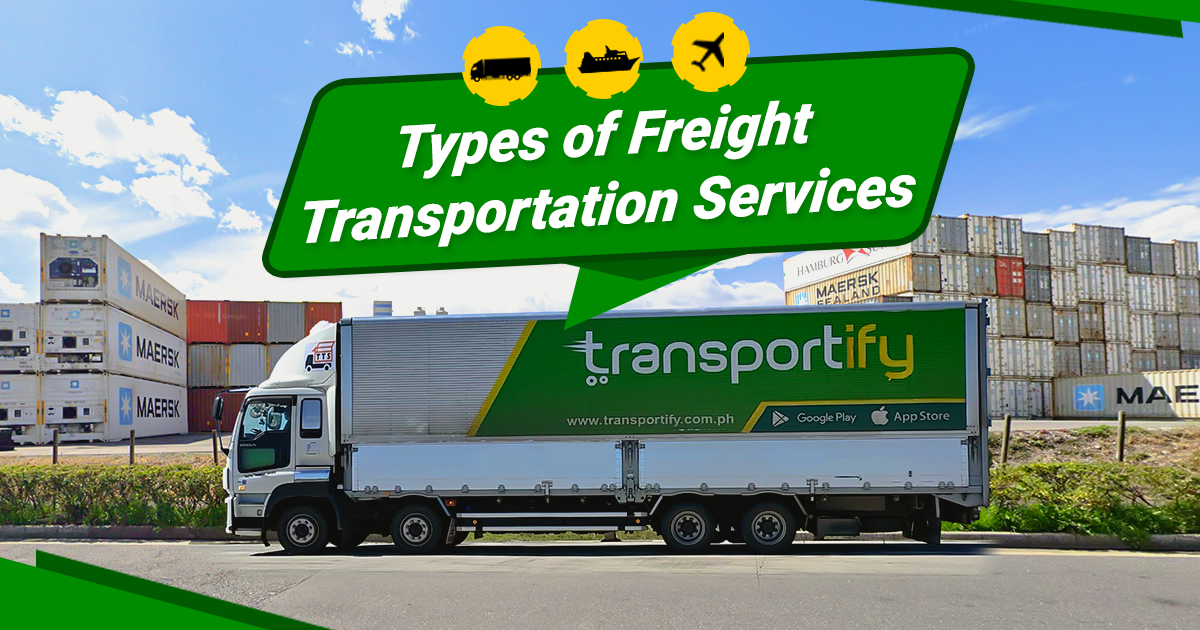
The different types of freight transportation services are structured logistics offerings that move goods using various operational models, transport modes, and service configurations. Each freight transportation service’s configuration depends on cargo type, delivery requirements, and the distance involved. The right freight service for a business depends on cargo weight, budget, and geographic borders. Types of freight services include land-based truckload services, ocean, air, and intermodal arrangements.
Freight transportation in the Philippines operates across road, sea, and air networks. Road freight holds the largest share of domestic cargo movement and is a common starting point for businesses shipping across Luzon, Visayas, and Mindanao. The country’s archipelagic geography means moving goods between major island groups traditionally requires multiple handoffs between trucks and ports. The handoffs add time, cost, and coordination complexity for shippers. Transportify offers freight shipping services that cover Full Truckload (FTL), Less-than-Truckload (LTL), and intermodal shipping via Roll-on, Roll-off (RoRo) vessels. Philippine businesses can move cargo by road and sea through a single platform without coordinating multiple providers separately.
1. Full Truckload (FTL) Freight
Full Truckload (FTL) freight is a freight transportation service where a shipper reserves the entire cargo space of a truck for one shipment. FTL freight services deliver a single shipper’s goods with no shared space and no intermediate stops for other cargo. FTL shippers pay a flat rate for the vehicle rather than paying per kilogram or cubic meter, regardless of whether the truck is fully loaded.
FTL services typically use vehicles ranging from 4-wheel closed vans to 10-wheel wing vans, handling cargo weights from around 2,000 kg up to 15,000 kg or more depending on the truck type. FTL works best for fragile goods, time-sensitive cargo, and high-volume shipments where filling most of the truck makes the flat rate cost-efficient. Businesses shipping large volumes between warehouses, distribution centers, or provincial routes benefit the most from FTL because the truck moves directly from origin to destination with fewer handling touchpoints. Businesses can book a Full Truckload (FTL) service with Transportify through the app or web dashboard. Transportify’s FTL service covers destinations across the Philippines.
2. Less Than Truckload (LTL) Freight
Less Than Truckload (LTL) freight is a freight transportation service where multiple shippers share the cargo space of a single truck. LTL shippers pay for the space their cargo occupies. LTL pricing is calculated per kilogram or per cubic meter. LTL services are more cost-efficient than FTL for shipments too small to fill an entire truck. LTL is designed for businesses that regularly ship cargo volumes below the threshold where reserving a full vehicle becomes economical.
LTL services in the Philippines handle shipments ranging from small pallets up to partial loads across 4-wheel or 6-wheel trucks. LTL is a practical option for SMEs and retail businesses that need to move goods between warehouses or distribution centers without waiting to accumulate a full truckload. Businesses looking for a Less Than Truckload (LTL) provider can book through Transportify. Transportify offers shared truck space across key routes in major regional distribution hubs.
3. Intermodal Freight Transportation
Intermodal freight transportation is a freight transportation service that moves goods using two or more transport modes within a single journey. Intermodal freight stays inside the same container throughout the trip to reduce the risk of damage. Standardized containers make mode-switching possible without repacking between legs. Documentation is also simplified since the cargo moves under a single set of shipping records across all transport legs.
The Philippines’ archipelagic geography makes intermodal freight a practical necessity for many routes. Single-mode delivery can’t connect most island-to-island shipments without at least one port transfer. A typical intermodal shipment travels by truck from a warehouse to a port, boards a vessel to cross to another island, then continues by truck to the final delivery point. Intermodal freight transportation also lowers per-unit shipping costs on long-distance routes by combining the strengths of each mode rather than relying on a single and less efficient option. Transportify supports intermodal freight transportation through its Interisland RoRo service. Transportify’s Interisland service covers routes across all major islands in the Philippines.
4. Rail Freight Transportation
Rail freight transportation is a freight transportation service that moves goods overland using cargo trains on fixed rail networks. Rail freight suits high-volume and long-distance shipments where road congestion and fuel costs make trucking less efficient. A single freight train carries cargo volumes equivalent to multiple road trucks, making rail a cost-competitive option for bulk commodities. Agricultural products, minerals, and manufactured goods are among the cargo types most commonly moved by rail.
Rail freight transportation remains limited in the Philippines compared to road and sea modes. The Philippine’s rail infrastructure has historically focused on passenger commuter lines rather than dedicated freight corridors. The Philippine National Railways (PNR) has endorsed integrating freight operations alongside the 147-kilometer North-South Commuter Railway (NSCR) project. The PNR is also pursuing cargo train operations between Calamba, Laguna and Legazpi, Albay.
5. Air Freight Transportation
Air freight transportation is a service that moves cargo by aircraft. Air freight transport offers the fastest transit times of any freight mode for both domestic and international shipments. Air freight suits high-value goods, perishable products, and urgent shipments where road or sea transit times are too slow to meet the delivery requirements. Air freight is the most expensive freight transport mode since pricing is calculated per kilogram or by dimensional weight, depending on which is higher.
Air freight transportation in the Philippines operates through carriers including Philippine Airlines (PAL) Cargo and Cebu Pacific Air Cargo. Air freight carriers serve domestic routes between major airports and international destinations across the globe. Strict limits apply to cargo dimensions and weight per flight, which makes air freight practical only for smaller, high-priority shipments rather than bulk cargo. Pharmaceutical shipments, electronics, and seasonal goods with tight market windows are among the cargo types where air freight is the most appropriate choice.
6. Ocean Freight (Sea Freight)
Ocean freight (Sea freight) is a freight transportation service that moves goods between ports using cargo vessels. Ocean freight is the primary mode for international and interisland shipments involving large cargo volumes. Ocean freight operates in two main configurations. Full Container Load (FCL) is where a single shipper reserves an entire 20-foot or 40-foot container. Less than Container Load (LCL) is where multiple shippers share container space and pay per cubic meter or per ton.
Ocean freight offers the lowest cost per unit of any freight mode, which makes it the default choice for bulk, non-urgent cargo. International carriers such as Maersk, Ocean Network Express (ONE), and MOL Logistics handle import and export cargo through major Philippine ports. Domestic sea cargo providers such as 2GO Logistics and Philippine Span Asia Carrier Corporation serve interisland routes connecting Luzon, Visayas, and Mindanao. Transit times range from a few days on domestic routes to several weeks for international shipments.
7. Drayage Services
Drayage is a freight transportation service that moves shipping containers over short distances. Drayage moves cargo between ports, rail yards, or terminals. Drayage forms the connecting leg in intermodal freight journeys by bridging the gap between the long-haul transport mode and the final destination. These services are billed as a flat rate per container move, with costs varying based on distance from the port, congestion surcharges, and container type.
Drayage services in the Philippines operate primarily at major port facilities such as the Port of Manila and Cebu. Trucks pick up inbound containers and deliver them to importer warehouses or return empty containers for export loading. Port congestion at the Port of Manila regularly affects drayage turnaround times, making reliable drayage providers a critical part of import and export logistics for Philippine businesses.
8. Heavy Haul / Oversized Freight Transport
Heavy haul freight transport is a freight transportation service that moves cargo exceeding standard legal weight and dimension limits for road transport. Heavy haul shipments require specialized vehicles, route planning, and regulatory permits before transport can begin. Oversized freight includes construction equipment, industrial machinery, large structural components, and prefabricated building materials that can’t fit inside standard enclosed trucks.
Heavy haul transport in the Philippines requires permits from the Department of Public Works and Highways (DPWH) for loads exceeding standard axle weight limits. Route surveys identify clearance restrictions such as low bridges and narrow roads before the shipment moves. Specialized equipment used for heavy haul operations includes lowbed trailers, extendable flatbeds, and multi-axle hydraulic platform trailers. Companies such as Larga Philippines and CBBE Inc. provide heavy haul and heavy lift transport for construction, energy, and infrastructure projects across the country.
9. Expedited Freight Services
Expedited freight is a freight transportation service that prioritizes speed of delivery over cost. Expedited freight moves cargo faster than standard freight schedules through dedicated vehicles, direct routing, and eliminated transit stops. Expedited freight suits urgent shipments such as production-critical parts, medical supplies, and perishable goods where a delay directly causes loss. Expedited freight services in the Philippines range from same-day truck dispatch to next-day interisland cargo delivery. Expedited freight rates run higher than standard freight because the carrier dedicates a vehicle exclusively to one shipment and bypasses consolidation stops.
10. Parcel / Courier Freight Services
Parcel freight is a freight transportation service that moves individual packages and small shipments directly from sender to recipient, within defined weight and dimension limits set by the courier provider. Parcel freight differs from FTL and LTL services in that it operates on a per-package billing model rather than a per-vehicle or per-space model. This makes parcel freight the most accessible option for individuals and small businesses shipping low-volume cargo.
Standard parcel delivery within Metro Manila typically takes one to three business days, while provincial and interisland deliveries may take three to seven days. Parcel freight services provide tracking, proof of delivery, and cash-on-delivery (COD) collection for e-commerce businesses shipping high volumes of small packages daily. Standard freight services don’t include these features in their base service offerings.
What is a Freight Transportation Service in Logistics?
A freight transportation service in logistics is a commercially organized system for moving goods through managed logistics operations. Freight transportation services do not just pertain to physical transport from one point to another. Freight shipping services combine carrier selection, route planning, shipment documentation, cost management, and cargo tracking into a coordinated delivery operation. The goal of freight transportation is to move goods efficiently within a supply chain.
Logistics management covers the full end-to-end supply chain including procurement, warehousing, inventory, and distribution. Freight transportation services handle the transport component of that system. Freight shipping ensures goods physically move from origin to destination through the right mode with the proper documentation. Freight transportation services in the Philippines involve road, sea, and air modes, coordinated to account for the country’s interisland geography and varying provincial infrastructure.
A freight transportation service also carries commercial and regulatory responsibilities that go beyond vehicle operation. Freight transport regulatory responsibility include managing shipping contracts, ensuring cargo insurance, handling customs documentation for cross-border shipments, and meeting compliance requirements set by agencies such as the Land Transportation Franchising and Regulatory Board (LTFRB) and the Philippine Ports Authority (PPA).
How do Freight Transportation Services Differ From Simple Trucking?
Freight transportation services differ from simple trucking in that they deliver a managed logistics layer on top of physical vehicle movement. Simple trucking moves cargo from Point A to Point B using a truck. Freight transportation services add coordination, routing optimization, shipment tracking, carrier management, and cargo handling protocols that simple trucking doesn’t include. Simple trucking suits short, direct, low-complexity deliveries where the shipper manages everything else. Freight shipping services suit businesses that need cargo to move through multiple transportation modes, or regulatory checkpoints without managing each step separately.
How do Freight Transportation Services Handle Different Cargo Types?
Freight transportation services handle different cargo types by matching the physical and regulatory characteristics of the cargo to the appropriate service configuration, vehicle type, and transport mode. Cargo weight, dimensions, temperature sensitivity, fragility, and hazard classification each determine which freight service applies. A shipment of frozen seafood follows a completely different freight pathway than a pallet of construction hardware, even if both travel the same route.
The matching process starts with cargo classification. Freight service providers assess whether cargo requires special packaging, permits, or dedicated vehicle space before assigning a service type. Standard dry cargo moves through FTL or LTL services without additional handling requirements. Cargo that falls outside standard parameters gets routed through specialized freight configurations that add equipment, documentation, and compliance steps to the base transport service.
Philippine businesses shipping across interisland routes face an additional layer of complexity in this matching process. A cargo type that qualifies for standard road freight within Luzon may require reefer vessel capacity, hazmat documentation, or special loading equipment once it crosses a sea leg to Visayas or Mindanao. Freight transportation services that cover multiple transport modes handle this cargo-to-service matching across every leg of the journey, including transfers beyond the first truck dispatch
What Types of Cargo Require Specialized Freight Transportation Services?
Cargo types that require specialized freight transportation services include perishables, fragile goods, oversized cargo, high-value goods, and hazardous materials. These cargo types share characteristics that fall outside what standard dry freight vehicles and handling procedures can safely accommodate. Each cargo type triggers a distinct set of service requirements, from equipment configuration to regulatory documentation.
- Perishables: Temperature-sensitive goods such as fresh produce, dairy, meat, and pharmaceuticals require cold chain freight services using refrigerated trucks. Consistent temperature control must be maintained across every leg of the journey, including port transfers.
- Fragile goods: Glassware, electronics, and ceramics require cushioned packaging and careful load securing to prevent breakage. Fragile cargo often moves via FTL to eliminate the additional handling touchpoints that LTL consolidation introduces.
- Oversized cargo: Construction equipment and industrial machinery exceed standard road dimension and axle weight limits require DPWH permits before transport begins. A pre-trip route survey is also required to identify clearance restrictions along the planned route.
- High-value goods: Jewelry, electronics, and currency require secure, monitored transport with limited handling access and cargo insurance. GPS-tracked dedicated vehicles or armed escort may apply depending on the shipment value and risk profile.
- Hazardous materials: Chemicals, flammable liquids, and compressed gases require classification under international hazmat standards and specialized containment packaging. Philippine regulations covering dangerous goods carriage by road, sea, and air must be met before the shipment moves.
Cargo that combines multiple specialized requirements demands freight service providers with multi-compliance capability across equipment, documentation, and handling protocols. Shippers benefit most from providers that manage these requirements as a single coordinated service rather than assembling separate vendors for each compliance layer.
How do Digital Platforms Change Freight Transportation Services?
Digital platforms change freight transportation services by replacing manual paper-based dispatch, and phone-dependent coordination with real-time systems that connect shippers and carriers through a single ecosystem. Booking, route assignment, driver dispatch, and shipment tracking now happen through web and mobile applications rather than through calls to brokers or physical freight offices. The shift to digital platforms reduce booking time from hours or days to minutes. Digital platforms also give shippers visibility over their cargo throughout the journey.
The digitization of freight also changes how pricing works. Traditional freight booking required negotiating rates with individual carriers, often without transparent benchmarks. Digital freight platforms publish rate structures upfront, allow instant price comparison, and generate delivery quotes before a booking is confirmed.
Transportify operates as a digital logistics marketplace that connects businesses with qualified drivers and vehicles through its web and mobile app, available 24/7 for on-demand and scheduled freight bookings. The platform supports real-time GPS tracking, in-app communication between shippers and drivers, and fleet management tools for businesses running regular cargo operations.
What Role does On-Demand Trucking Play in Freight Transportation Services?
On-demand trucking removes fixed scheduling constraints from freight transportation service. On-demand trucking allows businesses to book a truck at the time and location they need without committing to long-term contracts or preset dispatch windows. On-demand trucking fills the gap between standard scheduled freight services and the unpredictable cargo needs that businesses face due to seasonal demand spikes, last-minute orders, or urgent restocking requirements.
A business needing a truck outside scheduled hours in a traditional freight setup either waits or pays premium rates through spot market brokers. On-demand trucking platforms eliminate friction by maintaining a dynamic pool of available drivers and vehicles that can be allocated in real time. Fleet availability updates continuously on the platform, so dispatch decisions reflect actual supply rather than a fixed schedule.
On-demand trucking for Philippine businesses is useful for e-commerce operations, FMCG distribution, and construction supply chains where delivery timing directly affects downstream operations. Transportify’s on-demand service operates 24/7, allowing businesses to schedule pickups and deliveries at any hour without pre-arranged contracts. Transportify’s 24/7 service allows smaller businesses access to the same fleet flexibility that large logistics operators have traditionally reserved for enterprise clients.
How does Freight Transportation Impact Supply Chain Efficiency?
Freight transportation impacts supply chain efficiency by determining how fast, reliably, and cost-effectively goods move between each node in the supply chain. Reliable transport ensures on-time inventory arrivals and controls warehousing costs. Poor freight coordination compounds delays across the supply chain and raises the total cost of operations at every affected node.
The choice of freight service type directly affects supply chain performance metrics. Using FTL for a partial load inflates per-unit transport costs. Using LTL for a time-critical shipment risks delay from consolidation schedules. Matching the freight service to the shipment type keeps delivery time, vehicle utilization, and freight spend aligned with supply chain targets.
Digital freight platforms improve supply chain efficiency further by providing real-time tracking, automated route optimization, and delivery performance data across shipments. Philippine businesses that integrate digital freight tools gain visibility over transit times, carrier performance, and cost per delivery. Logistics service providers in the Philippines that adopt technology-driven freight coordination show measurable improvements in on-time delivery rates and reductions in logistics cost as a percentage of revenue according to a study published in the Asian Journal of Logistics and Supply Chain Management.
Can you get a Trucking Quote first before booking a Freight Transportation Service?
Yes. A trucking quote is available before committing to a freight transportation service booking. It is a recommended first step to get a trucking quote for any business comparing freight options. A trucking quote estimates the cost of transporting goods based on vehicle type, cargo weight and dimensions, pickup and delivery locations, and any additional service requirements such as loading assistance or insurance.
Transportify provides instant trucking quotes through its online Price Wizard tool, which generates rate estimates across vehicle types ranging from sedans and light vans to wing vans and 6-wheel forward trucks. Getting a quote before booking allows businesses to compare vehicle options and plan delivery budgets accurately.
What Types of Vehicles are Used Across Freight Transportation Services?
Vehicles used across freight transportation services range from motorcycles handling small parcels to wing vans and container trucks moving industrial cargo across provincial and interisland routes. Vehicle selection depends on cargo weight, volume, road access at the delivery point, and the freight service type being used.
- Motorcycle: Motorcycles carry small parcels and documents typically under 20 kg, suited for same-day courier deliveries within urban areas where speed and lane flexibility matter more than cargo capacity.
- Sedan: Sedans handle light cargo up to around 200 kg, used primarily for small business deliveries, document transfers, and same-day parcel services within Metro Manila and nearby urban centers.
- MPV (Multi-Purpose Vehicle): MPVs carry cargo up to approximately 300 kg, suited for small retail shipments, grocery deliveries, and e-commerce fulfillment runs within city limits.
- Van: Vans handle cargo up to around 500 to 600 kg. Vans, such as the L300, are commonly used for LTL deliveries, retail distribution, and small business freight within urban and near-provincial routes.
- Pickup Truck: Pickup trucks carry cargo up to approximately 1,000 kg in open or covered beds, suited for construction materials, hardware supplies, and bulky items that don’t require an enclosed cargo area.
- Light Truck: Light trucks carry up to 2,000 kg of cargo in an enclosed body. Light truck, such as 4-wheeler closed vans, are used for FTL and LTL freight, appliance deliveries, and temperature-controlled shipments fitted with refrigeration units.
- 6-Wheel Forward Truck: Six-wheel forward trucks carry up to 7,000 kg across an 18-foot cargo area. 6-wheeler forward trucks are suited for medium-volume FTL freight, inter-city distribution, and retail chain replenishment runs.
- 10-Wheeler Truck: Ten-wheeler trucks handle cargo loads of up to 10,000 to 12,000 kg,. 10-wheeler trucks are used for high-volume FTL freight, bulk commodity transport, and provincial distribution across Luzon.
- Wing Van: Wing vans carry up to 15,000 kg with side-opening panels that allow forklift access for pallet loading. Wing vans are the standard vehicle for large FTL freight, FMCG distribution, and interisland cargo via RoRo.
- Container Truck: Container trucks transport 20-foot or 40-foot ISO containers between ports, warehouses, and distribution centers, primarily used for drayage, intermodal freight, and import or export cargo movements.
Shippers that match vehicle capacity to actual cargo weight and volume before booking ensure control over the per-delivery freight spend. Transportify offers sedans, MPVs, vans, pickup trucks, closed vans, 6-wheel forward trucks, and 10-wheel wing vans. Transportify’s wide fleet options are bookable on-demand through the app for same-day and scheduled deliveries across Luzon, Visayas, and Mindanao.
How does Last-Mile Delivery Fit Into Freight Transportation Services?
Last-mile delivery fits into freight transportation services as the final stage of the delivery journey. Last mile delivery is when the cargo moves from a distribution hub to the end recipient’s address. Last-mile delivery accounts for a significant share of total delivery cost despite covering the shortest physical distance.
Last-mile logistics in the Philippines faces specific challenges driven by urban density and fragmented road infrastructure. Metro Manila traffic, narrow barangay roads, and building access restrictions in commercial and residential areas slow down delivery vehicles and increase time-per-stop. The Philippines last-mile delivery market is projected to grow significantly through 2035 according to the IMARC Group. The market growth is driven by rising e-commerce volumes and consumer expectations for same-day or next-day delivery.
Freight transportation services integrate last-mile delivery through dedicated urban delivery fleets, parcel handoff networks, and on-demand booking platforms. Transportify supports last-mile freight by giving businesses access to a range of vehicle sizes for same-day dispatch, allowing shippers to choose a vehicle matched to the delivery point’s road and access conditions rather than defaulting to a fixed fleet size.
What is the Role of Route Optimization in Freight Transport?
Route optimization in freight transport is the process of calculating the most efficient delivery path for a vehicle based on stop sequence, cargo weight, delivery time windows, traffic conditions, and vehicle capacity. Route optimization reduces fuel consumption and total delivery time.
Route optimization in Philippine freight operations addresses specific challenges including Metro Manila traffic congestion, provincial road quality variations, and port access scheduling at major cargo terminals. AI-driven route optimization tools reduce trucking fuel costs by an estimated 15 to 20% compared to manually planned routes according to recent studies by JUSDA. Route optimization tools factor in real-time traffic data, delivery priorities, and vehicle constraints to generate routes that human planners can’t consistently replicate at scale.
Freight transportation platforms that embed route optimization into their dispatch systems give businesses a direct efficiency advantage. Transportify’s platform uses automated routing and real-time GPS tracking to keep drivers on optimized paths throughout a delivery run. The platform reduces idle time and improves on-time delivery rates for both urban and provincial shipments
How do Freight Transportation Services Operate in Urban vs Provincial Areas?
Freight transportation services operate differently in urban and provincial areas because the infrastructure, road conditions, delivery density, and regulatory environment vary significantly between the two contexts. Urban freight operations in Metro Manila contend with high traffic congestion, number coding restrictions, limited truck lanes, and dense delivery stop sequences that require smaller vehicles and tighter scheduling. Provincial freight operations face different constraints including longer travel distances, unpaved or low-capacity roads, limited fuel and maintenance access points, and lower delivery density per route.
Urban freight in Metro Manila benefits from better road infrastructure and more carrier options but loses efficiency to congestion and access restrictions. The Metropolitan Manila Development Authority (MMDA) enforces truck ban hours that restrict large freight vehicles from operating on major roads during peak hours, forcing logistics providers to schedule deliveries outside restricted windows or use lighter vehicles for urban drops. Logistics costs in the Philippines are elevated, partly because urban congestion and interisland geography force freight to take longer and more expensive routes than direct road delivery would require.
Provincial freight operations trade congestion delays for distance and road quality challenges. Roads in many provincial areas outside major highways are narrower and less maintained, limiting the size and weight of vehicles that can operate safely on those routes. Freight providers serving provincial destinations often rely on consolidation hubs in regional centers such as Cebu, Davao, and Cagayan de Oro to redistribute cargo from larger interisland vessels or trunk road shipments into smaller vehicles suited for local distribution.
What Regulations Affect Freight Transportation Services in the Philippines?
Regulations that affect freight transportation services in the Philippines come from multiple government agencies, each covering a specific transport mode or operational requirement. The LTFRB is the primary regulator for road freight, requiring trucks used for commercial freight to hold a Certificate of Public Convenience (CPC) or a valid Provisional Authority (PA) before operating on public roads. Operating a freight truck without a valid CPC or PA constitutes a colorum violation resulting in penalties including vehicle impoundment and fines.
The LTFRB sets operational rules covering vehicle roadworthiness, driver accreditation, and franchise territory coverage. Freight trucks must maintain current LTO registration, valid third-party liability insurance, and compliance with MMDA truck ban schedules in Metro Manila. Hazardous cargo transport carries additional compliance requirements under Department of Transportation (DOTr) and Environmental Management Bureau (EMB) rules covering dangerous goods classification, packaging standards, and route approvals.
The Philippine Ports Authority (PPA) and the Maritime Industry Authority (MARINA) regulate port access, vessel certification, and cargo handling standards at commercial ports. Air cargo operations fall under Civil Aeronautics Board (CAB) and Civil Aviation Authority of the Philippines (CAAP) jurisdiction, covering carrier licensing and cargo acceptance standards. Philippine businesses using freight transportation services across multiple modes need to work with providers that maintain active compliance across all relevant regulatory bodies.
How do Businesses Choose the Right Freight Transportation Partner?
Businesses choose the right freight transportation partner by evaluating reliability, pricing transparency, fleet availability, geographic coverage, and technology integration against their specific shipping requirements. A provider that performs well on one dimension but poorly on another can create operational gaps, such as a carrier with competitive rates but limited provincial coverage leaving a business unable to fulfill orders outside Metro Manila.
Reliability is the most important factor to verify before committing to a freight partner. Businesses should check on-time delivery track records, client references, and whether the provider holds active LTFRB franchise documents and LTO-registered vehicles. A freight provider operating without complete compliance documentation exposes the shipper to service interruptions and liability risks if vehicles are impounded during transit.
Pricing transparency and technology integration increasingly separate strong freight partners from weak ones. Providers that offer upfront rate calculators, real-time shipment tracking, and digital booking eliminate the coordination overhead that erodes productivity for shipping teams. Fleet availability matters especially for businesses with variable or seasonal cargo volumes, since a provider with a limited fleet can’t scale up when demand spikes. Transportify meets these criteria as a freight transportation partner through its digital platform, transparent rate calculator, 24/7 booking availability, and a fleet covering vehicles from sedans to wing vans across Luzon, with interisland coverage via RoRo to Visayas and Mindanao.







 Chat
Chat